Internal links pass authority between your pages, tell Google which content matters most, and guide buyers toward conversion. They cost nothing except time, and the benefits compound as your site grows. Most local service websites use them by accident, not by design.
Most local business SEO attention goes to the visible elements: title tags, meta descriptions, writing content for keywords. These matter. But there’s a parallel system happening inside your site, the network of links between your own pages, that most businesses never build deliberately.
Internal linking is one of the highest-ROI technical SEO actions available to a site that has existing content. For a local service business with a handful of service pages and a growing blog, a few hours of deliberate internal linking work can move rankings on pages that have been underperforming for months, without creating a single new piece of content.
Table of Contents
| Internal links are free, compound over time, and most local businesses never build them deliberately. That’s the opportunity. |
What Internal Links Actually Do
When Google crawls your site, it follows links. A page with many internal links pointing to it gets three things that a page with no internal links doesn’t:
- More frequent crawling. Google’s crawler returns to pages it finds referenced from other pages more often. A page that nobody links to may be crawled infrequently, which means ranking signal changes take longer to be recognized.
- Link equity flow. Each internal link passes a portion of the linking page’s authority to the destination page. A homepage that earns external links and has strong ranking signals becomes a source of authority for every page it links to. A service page linked from the homepage benefits from that authority flow.
- Topical relationship signals. Internal links with descriptive anchor text tell Google about the relationship between content. A blog post about GBP optimization that links to your local SEO service page with the anchor text ‘local SEO services’ signals that these two pieces of content are topically related and that the service page is the commercial destination for the blog’s informational content.
These three effects work together. A deliberately linked site architecture compounds authority into the pages you most want to rank, while a random or accidental architecture distributes authority inefficiently.
The Hub-and-Spoke Architecture for Local Service Businesses
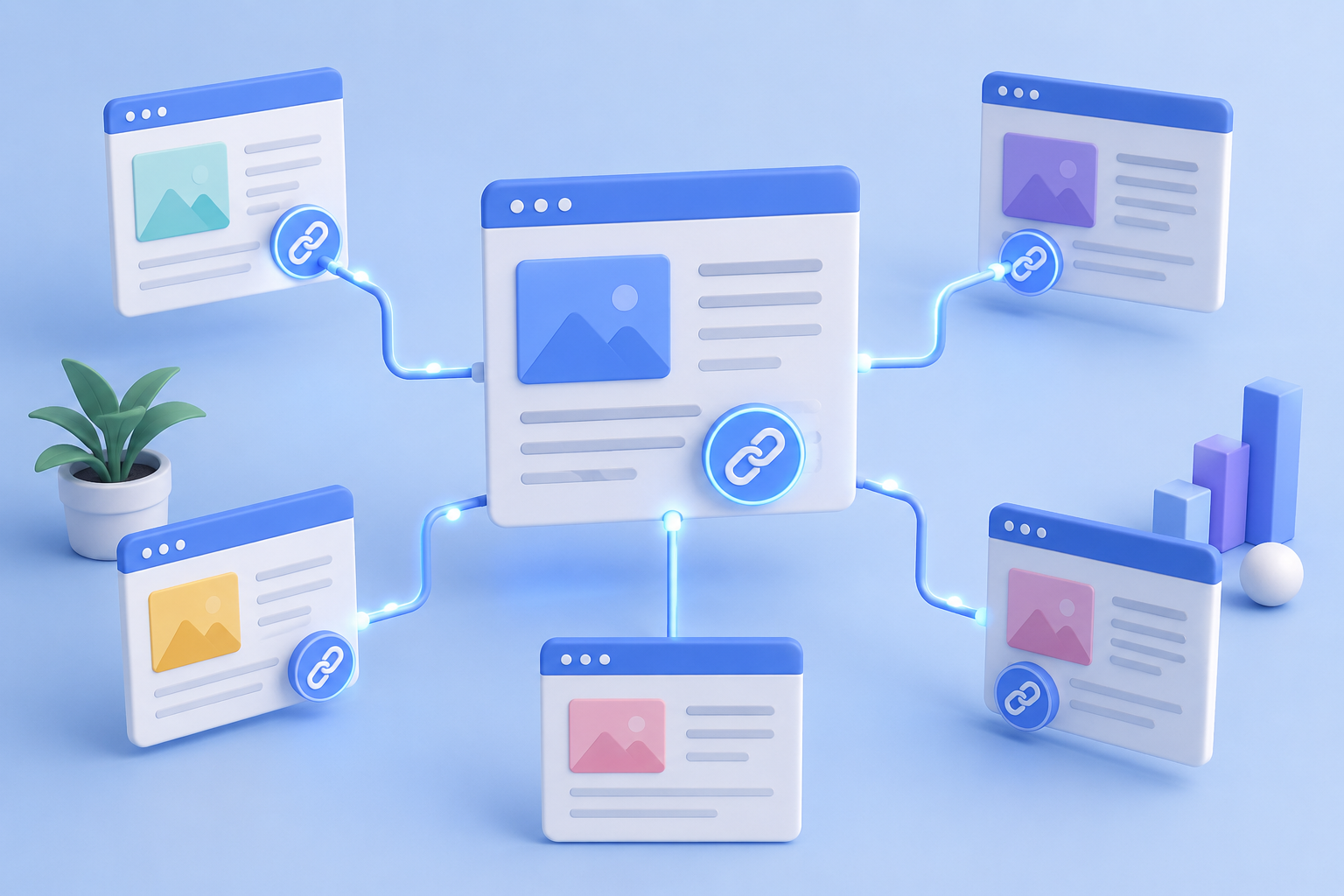
The most effective internal linking structure for a local service business is a hub-and-spoke model. Your most important pages are hubs. Your service pages, city pages, and blog posts are spokes. Links flow from hubs to spokes and from spokes back to hubs.
In practice, this means: every service page links to your primary city hub. Every city page links to your relevant service pages. Every blog post about a topic links to the service page for that topic. The links should be natural and useful to the reader, but they also need to exist for Google.
Most local service websites have the homepage linking to service pages but no reverse links, no city page cross-links, and blog posts that float without any connections to service pages. The architecture exists by accident rather than design.
Anchor Text: What to Use and What to Avoid
The clickable text in an internal link tells Google something about the destination page’s topic. The principle is simple: use descriptive text that reflects what the destination page is about. ‘Learn more’ tells Google nothing. ‘Local SEO services in Johnson City’ tells Google the destination is a local SEO service page serving the Johnson City market.
You don’t need to optimize every internal link anchor text. Google is sophisticated enough to understand context. But avoid generic anchor text on your most important links, and avoid two specific patterns:
- Over-optimization: Using the exact same keyword-rich anchor text for every link pointing to a page. ‘Johnson City digital marketing agency’ as the anchor on every internal link to your homepage looks unnatural. Use natural language variants: ‘our Johnson City team,’ ‘the agency,’ ‘our digital marketing services.’ Google understands they all reference the same destination.
- Generic anchors on important links: ‘Click here,’ ‘read more,’ and ‘learn more’ convey no topical signal. Replace these with descriptive text on any link pointing to a page you want to rank.
Blog Posts Are Your Internal Linking Engine
Every blog post you publish is an opportunity to send authority to your service pages. A post about technical SEO links to your SEO services page. A post about GBP optimization links to your local SEO page. A post about web design cost links to your web design page.
This is why a blog post that ranks on page two for a relatively niche query still has value even if it’s not generating many clicks. If it’s linking to your service pages, it’s passing whatever authority it earns through its own rankings and any external links it attracts back into your core commercial pages.
The systematic approach: every blog post published should have at least one internal link to a relevant service page. Treat this as a publishing checklist item, not an afterthought. A blog with thirty posts, each linking once to a relevant service page, creates thirty internal link paths flowing into your service pages from content that’s earning its own impressions.
| Every blog post is an internal link opportunity. A post ranking on page two with links to your service page is still passing authority to the page you actually want to rank. |
Finding and Fixing Orphaned Pages
Run a crawl of your site using Screaming Frog‘s free tier (up to 500 URLs) and filter for pages with zero or one inbound internal links. These orphaned pages may have excellent on-page SEO and still underperform because they’re not receiving authority from the rest of your site.
The most common orphaned pages on local service websites:
- Service pages added to the navigation menu but never linked from blog posts or related service pages
- City pages built and published without being linked from the homepage, service pages, or other city pages
- Blog posts published without links from existing related posts
- Landing pages created for specific campaigns that were never linked from the main site
The fix is simple: add internal links to orphaned pages from relevant existing content. Three to four quality internal links pointing to a previously orphaned page can produce measurable ranking improvement within one to two crawl cycles after Google processes the updates.
The Internal Linking Audit: Five Pages, Ten Minutes
A quick audit that reveals your most important internal linking gaps:
- Identify your five most important pages. The pages you most want ranking. Usually your homepage, primary city hub, and top two or three service pages.
- Check inbound internal links for each. In Google Search Console, go to Links > Internal Links and search for each priority page. Or use Screaming Frog’s inlinks report. Note the count.
- Check your five highest-traffic pages. Are they linking to your priority pages? If your homepage gets 60% of your traffic and has no links to your Johnson City city hub, you’re leaving authority flow on the table.
- Check your most recent five blog posts. Does each one link to at least one relevant service page? If not, add the links now.
- Search for pages with zero inbound links. These are your orphaned pages. Add them to a fix list.
| Page Type | Inlinks | Status | Action |
| Service page | 0 | Orphaned | Add links from homepage, city hub, related blog posts |
| Service page | 1-2 | Weak | Add 2-3 links from related blog posts |
| Service page | 5+ | Healthy | Monitor; add links from new blog posts as published |
| City page | 0 | Orphaned | Link from homepage, all relevant service pages, region blog posts |
| Blog post | 0 | Orphaned | Link from at least 2 related existing posts |
| Blog post | 1+ | Acceptable | Ensure it links out to at least one service page |
| Want a site architecture and internal linking audit for your local business website? 1-FIND’s SEO and AEO services include internal link architecture review, orphaned page identification, and a structured linking plan that concentrates authority into your most important commercial pages.1-find.agency/seo-aeo |