Reputation management for a local business is three separate problems. Most businesses treat all three as one problem — ‘get more stars’ — and miss the other two entirely.
The three problems are distinct and require different approaches. What shows up when a prospect Googles your business name: the search result, the knowledge panel, the map listing, the review platforms. What your review profile communicates once they find it: not just the rating but the content, the recency, the response pattern. And how you handle the reviews that work against you: negative reviews, fake reviews, and outdated mentions that no longer reflect your business.
Each of these has an active management strategy. None of them can be fixed by ‘getting more five-star reviews’ alone, though that remains part of the answer to all three. This post covers each one. For the specific mechanics of generating more reviews, the review timing and strategy post covers that specifically.
Table of Contents
| Getting more five-star reviews is part of the answer to all three reputation problems. It’s not the whole answer to any of them. |
Problem 1: What Shows Up When Prospects Google Your Name
The first reputation problem happens before a prospect ever reads a review. When they type your business name into Google, what appears in the first ten results tells a story. Managing that story is the first layer of reputation management.
The knowledge panel
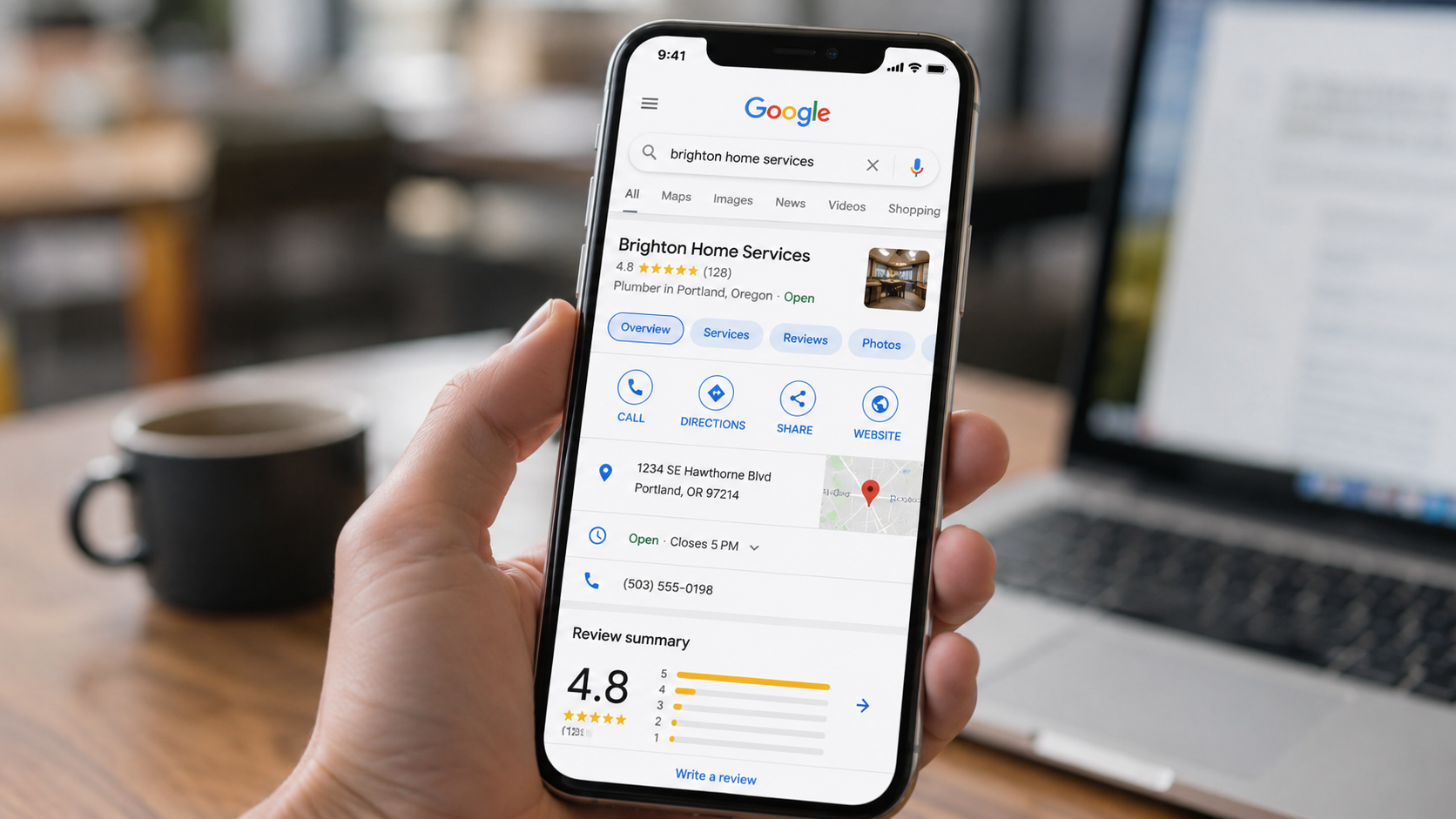
Your Google Business Profile is typically the first thing a prospect sees when searching your business name directly — the right-side knowledge panel with your photos, rating, hours, and contact info. A knowledge panel with outdated photos, old hours, no recent reviews, and unanswered Q&A sends a signal about your business before the prospect has read a single review or visited your website.
Active management of your knowledge panel means current hours, recent photos, recent reviews with responses, populated Q&A, and accurate business information. This is the most visible real estate in your search result and the one most businesses treat as a one-time setup.
What ranks for your business name
Beyond the knowledge panel, the first page of results for your business name typically includes your website, possibly your social media profiles, your GBP listing, review platform pages (Yelp, Facebook, BBB), and occasionally press coverage or directory listings.
For most local businesses, the main risk is a negative Yelp page, a BBB complaint, or an unflattering news mention ranking on the first page. You can’t remove legitimate third-party content, but you can displace it by ensuring that your own properties (website, GBP, LinkedIn, social media) and positive third-party properties rank strongly. A well-maintained website, active social media, and a strong GBP make it difficult for a single negative listing to dominate page one.
Review platform diversity
Your Google reviews are the most visible and most influential, but they’re not the only platform a prospect checks. Depending on your industry, Yelp, Facebook, Houzz, Angi, Avvo, or industry-specific directories may also appear prominently. A business with 80 Google reviews and a 2.1 Yelp rating has a reputation management problem on Yelp regardless of how strong the Google profile is.
Audit every platform that ranks for your business name and assess whether the rating and review content there is consistent with what you’re showing on Google. Platforms with negative gaps need the same review generation attention as Google.
| Brand Name Search Audit Search your exact business name in an incognito browser. Note the first 10 results. Check: does your website rank first? Is your GBP knowledge panel complete? Check: are there any review platforms in the results with ratings below 4.0? Check: is there any negative press, complaints, or unflattering content in the results? Check: are your social media profiles professional and current? Repeat this every 90 days. The results change over time. |
Problem 2: What Your Review Profile Actually Communicates
A prospect who finds your GBP or review profile isn’t just looking at the star rating. They’re reading the reviews themselves, looking at how recent they are, and paying attention to how you’ve responded. Each of these tells them something different.
The star rating threshold
According to BrightLocal’s Local Consumer Review Survey, the majority of consumers won’t use a business with a rating below 4.0. A 3.9 average is functionally different from a 4.0 — the first gets dismissed at a glance, the second gets evaluated. Getting above 4.0 and maintaining it is the minimum threshold, not the goal.
Review recency
A business with 90 reviews and the most recent from 14 months ago communicates something different than a business with 40 reviews and 8 in the last 90 days. The first looks like a business that was once active and may no longer be. The second looks like an active business with consistent customer flow. Prospects use review recency as a proxy for current business activity.
The content of reviews, not just the rating
What reviews say matters as much as how many there are. A collection of reviews that say ‘Great service, would recommend’ conveys less specific reassurance than reviews that describe the type of work done, name the practitioner they worked with, mention the city, and describe what made the experience different.
Specific review language also serves as a local SEO signal. A roofing company whose reviews frequently mention ‘Johnson City,’ ‘storm damage,’ ‘replaced our roof,’ and ‘fast response’ gets better relevance matching for those specific queries than one with equivalent ratings but generic review language.
Your response pattern
Prospects read your review responses, particularly on negative reviews. A business that responds to every review, including difficult ones, signals attentiveness and professionalism. A business with 60 reviews and no responses looks like nobody is watching, which raises the question of whether anybody is running the place day-to-day.
| A business with 60 reviews and no responses looks like nobody is watching. Prospects read that signal before they read any individual review. |
Problem 3: Handling Reviews That Work Against You
This is the most nuanced and most mishandled aspect of reputation management. How you respond to negative reviews, fake reviews, and outdated content determines whether those reviews hurt you once or hurt you every time a prospect reads them.
Responding to negative reviews
The response to a negative review is read by every future prospect who sees that review. A defensive, dismissive, or argumentative response damages your reputation more than the original negative review did. A calm, professional response that acknowledges the concern and offers to make it right demonstrates character. Character is exactly what a prospect evaluating you for the first time is looking for.
| Review Type | Response Tone | What to Do | What to Avoid |
| Positive (5-star) | Warm, specific | Acknowledge something specific from their review, thank by name, add one trust signal | Generic copy-paste template |
| Neutral (3-4 star) | Professional, appreciative | Thank them, acknowledge any concern mentioned, invite them to reach out directly | Dismissing the concern |
| Negative (1-2 star) | Calm, professional | Acknowledge the concern without admitting fault, offer to resolve offline, provide direct contact | Arguing, being defensive, blaming the customer |
| Fake or competitor review | Neutral | Flag for removal via Google’s process. Do not respond publicly | Engaging publicly — draws attention to it |
| Outdated / no longer accurate | Factual, professional | Briefly note what has changed if relevant, offer current contact | Over-explaining or being dismissive |
Flagging fake or competitor reviews
Google allows you to flag reviews that violate its policies: reviews from non-customers, reviews posted by a competitor or disgruntled former employee, spam, or content that violates community guidelines. The flagging process goes through your GBP dashboard and is reviewed by Google.
The process takes time and is not guaranteed. Google doesn’t always remove reviews that you believe are fake. For reviews that clearly violate policy (the reviewer has no history of your business, or the account was created specifically to leave a negative review), flag them and be patient. For reviews that are negative but may be legitimate even if unfair, respond professionally and move on.
What never helps: responding publicly to a fake review as if it were legitimate, or responding in a way that draws more attention to it. A professional non-engagement response: ‘We’re unable to find a record of this interaction. Please contact us directly at [number] so we can look into this’ is the right approach when you’re uncertain whether the review is genuine.
The dilution strategy for persistent negative reviews
If you have negative reviews that can’t be removed (legitimate complaints from real customers, older reviews where the issue has been resolved), the most effective management strategy is dilution through volume. A business with 4 negative reviews out of 80 total is at 95% positive. A business with 4 negative reviews out of 12 total has a visible problem.
Consistent review generation (the same systematic approach covered in the review timing post) is the long-term answer to persistent negative reviews. Each new positive review dilutes the visible impact of old negative ones and signals to prospects that the negative experiences were exceptions, not patterns.
Proactive Reputation Management: What to Do Before Problems Arise
Reactive reputation management (responding to negative reviews, flagging fake ones, fixing GBP) is necessary but not sufficient. Businesses with the strongest reputations have systems that build their reputation proactively before problems surface.
- Systematic review generation. An automated post-job review request that goes out within 24 hours ensures consistent review velocity without relying on anyone remembering to ask. Reviews arriving consistently month after month dilute any negatives and build the recency signal that algorithms favor.
- Regular GBP monitoring. Check your GBP at least monthly for new reviews, Q&A submissions, and suggested edits from the public. Google allows anyone to suggest an edit to your business information, and those suggestions can sometimes go live without your approval. Catching incorrect edits before they’re indexed prevents problems that take weeks to reverse.
- Google Alerts for your business name. A free Google Alert for your business name, your owner’s name, and your primary service plus city combination sends you an email whenever new content mentioning those terms is indexed. This is how you find out about a news mention, a forum complaint, or a competitor’s comparative content before a prospect finds it instead.
- Monitoring review platforms beyond Google. Set up profile claims on every platform that ranks for your business name, even if you don’t actively use them. An unclaimed Yelp profile with a negative review you’ve never seen is a reputation problem that’s been visible to prospects for months.
| Monthly Reputation Management Checklist Check GBP for new reviews (respond to all within 48 hours) Check GBP for suggested edits or Q&A submissions Search your business name in incognito — look for new negative content in the results Check Yelp, Facebook, and any industry-specific platforms for new reviews Verify that your automated review request sequence is running correctly Note current review count and average rating as a baseline for next month |
Reputation Management for Different Business Types
High-trust professional services (accountants, financial planners, attorneys)
Review content matters more than volume in this category. One detailed review from a client describing a specific situation handled well is worth more than five generic five-star ratings. Focus review prompts on specificity. Monitor LinkedIn and professional association profiles as additional reputation surfaces where peers and referral sources will check.
Home services and contractors
Volume and recency are the primary signals. A roofing company with 15 reviews from the past 90 days ranks and converts better than one with 60 reviews spread over three years. Prioritize getting reviews after every completed job. The language in reviews should mention the specific job type and city — this serves both the reputation signal and the local SEO signal.
Healthcare and dental
HIPAA constraints apply to review responses: you cannot confirm that a reviewer is your patient or reference any aspect of their treatment in your response. A standard response formula that thanks the reviewer and offers to discuss concerns privately by phone is the safe approach for any health-related review, positive or negative.
| Want a reputation management system that runs without you thinking about it? 1-FIND’s business automation and local SEO services include review velocity systems, GBP monitoring, and reputation tracking for local businesses in the Tri-Cities. Set up once, running consistently, without adding to your daily workload. |