1-FIND audited 75 home services contractors across the Tri-Cities in May 2026. Every trade category showed the same pattern: Google Business Profiles average 82.8 out of 100. Websites average 65.8. That 17-point gap is where customers get lost.
The 2026 Tri-Cities Home Services Digital Visibility Study evaluated HVAC, plumbing, electrical, roofing, and tree service companies across Johnson City, Kingsport, and Bristol on five technical dimensions: schema markup, technical SEO, HTTPS security, Lighthouse performance, and Core Web Vitals. That data was combined with an independent Google Business Profile audit to produce a Combined Visibility Score (CVS) for each business.
The finding that stands out most isn’t which trade did best or which city had the highest scores. It’s the structural gap that showed up consistently across all 75 entries: local contractors have invested meaningfully in their Google Business Profiles and significantly less in the websites those profiles link to.
Table of Contents
| Average GBP Health Score: 82.8. Average Website Health Score: 65.8. Contractors are earning the click from a strong profile and losing the customer on the landing. |
The Gap by Trade Category
The 17-point average gap between GBP and website scores was present in every trade category. Roofing had the widest spread. Tree service had the lowest scores on both sides. Plumbing led on both measures but still showed a meaningful gap.
| Trade Category | Avg GBP Score | Avg Website Score | Gap (GBP minus Website) |
| Plumbing | 85.6 | 65.6 | 20.0 points |
| HVAC | 83.5 | 67.2 | 16.3 points |
| Electrical | 82.0 | 68.0 | 14.0 points |
| Roofing | 82.4 | 63.0 | 19.4 points |
| Tree Service | 80.3 | 62.8 | 17.5 points |
| All categories | 82.8 | 65.8 | 17.0 points average |
The consistency of the gap across every category makes it a market-wide pattern rather than a trade-specific problem. Contractors in this region have learned to optimize their Google presence. The website on the other end of that profile hasn’t received the same attention.
Why This Matters: The GBP-to-Website Handoff
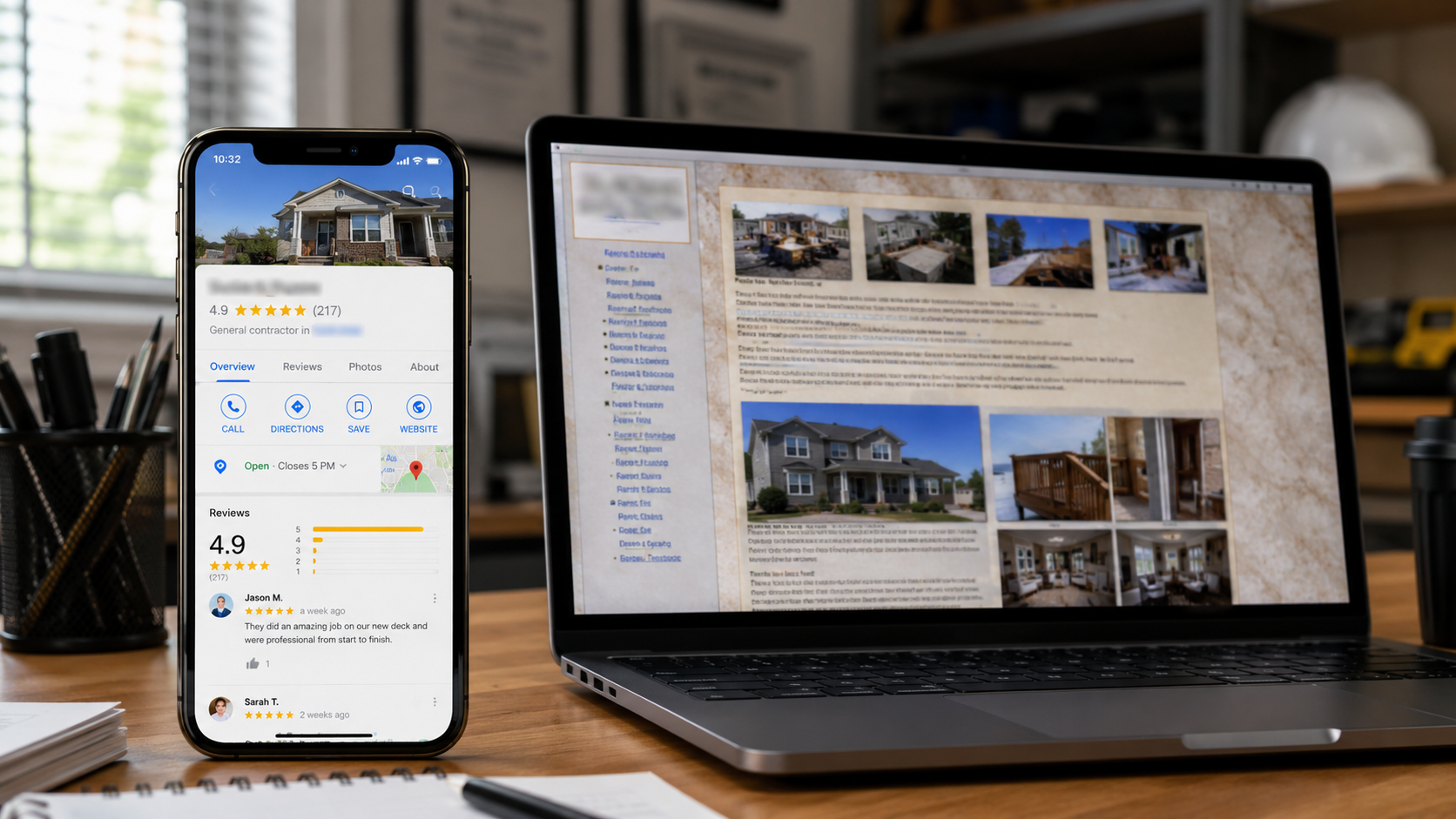
A Google Business Profile is not the end of the conversion process. It’s the beginning. A prospect who finds a contractor through a Google Maps search sees the star rating, the review count, the photos, the hours. They form an initial impression. Then they tap the website link.
What happens at that tap is what the gap measures. A customer who taps through from a five-star GBP listing to a website that loads slowly, displays poorly on mobile, or presents content that doesn’t match the polish of the profile has already started revising their first impression.
The study’s scoring breaks down why this happens technically. Website Health Scores reflect five factors: schema markup, technical SEO signals (sitemap, canonical, robots configuration), HTTPS security, Lighthouse performance, and Core Web Vitals. The average mobile Lighthouse performance score across all 75 audited sites was 65 out of 100, a score that typically reflects uncompressed images,, render-blocking resources, and plugin overhead on WordPress sites. Scores in the 50s and low 60s, which were common in this sample, produce perceptibly slow page loads on mobile devices.
Mobile is where most local service searches happen. A slow mobile website that follows a strong GBP profile is a conversion problem regardless of how well the profile is optimized.
| The Average Tri-Cities Contractor Website, By the Numbers Average Website Health Score: 65.8 / 100 Average mobile Lighthouse performance score: 65.0 / 100 LocalBusiness schema present: 52.0% of sites FAQ schema present: 6.7% of sites No company in the 75-entry sample scored 90 or above on the Combined Visibility Score Only 11 of 75 entries (14.7%) crossed the 80-point threshold Source: 2026 Tri-Cities Home Services Digital Visibility Study, 1-FIND SERVICES |
The Roofing Gap Is the Widest
Among the five trade categories, roofing had the largest average spread between GBP and website scores at 19.4 points. The average roofing GBP Health Score was 82.4, consistent with the market average. The average roofing Website Health Score was 63.0, the second-lowest in the study.
Roofing companies also had the thinnest review profiles in the sample. The average roofing company had 77 Google reviews, and seven of the 15 roofing entries had fewer than 50. Compare that to plumbing, where the average was 602 reviews per profile.
The review volume gap makes sense given the nature of the work. A homeowner who has a roof replaced rarely needs another roof for 20 to 30 years. The repeat-customer review accumulation that plumbing and HVAC benefit from doesn’t exist in roofing. Each new review requires a new job and a deliberate ask, which means review generation systems matter more in roofing than in any other trade covered in this study.
The wide website gap suggests that roofing companies in this market have invested in their Google presence while the website has been a lower priority. For a trade where the average job is among the highest-value in home services, that gap has a direct revenue cost.
The Trust Architecture Problem
The study framing that helps explain why this matters: think of a prospect’s path from first search to first call as a trust architecture. Each touchpoint either builds or erodes the trust that was established at the previous step.
A polished GBP profile with 120 reviews, active photos, current hours, and a complete service list builds significant trust before the prospect has ever seen the website. That trust is an asset. The question is what the website does with it.
A website that loads in 4 seconds on mobile, has no visible credentials, uses stock photos instead of real team photos, and has service descriptions that could belong to any contractor in any market does not build on that trust. At best, it holds it steady. At worst, it raises questions the GBP had answered.
This is the structural problem the 17-point gap describes. The GBP is working. The website is not amplifying that work.
| A strong GBP builds trust before the prospect reaches the website. A weak website spends that trust before the prospect calls. |
What the Data Suggests About Competitive Opportunity
Only 11 of the 75 audited entries scored 80 or above on the Combined Visibility Score. No company in the sample reached 90. The top-performing individual entry scored 89.8, achieved by a multi-trade regional operator with a perfect 100/100 GBP Health Score and an 83/100 Website Health Score.
That ceiling is notable. In a market where the best-performing business scored 89.8 and no one reached 90, the improvement threshold to become the strongest digital presence in a trade category is not a high bar. A contractor who closes the gap between their GBP and website scores — bringing their website into alignment with the quality signals their profile already sends: this is a clear competitive differentiation path.
The full study data, methodology, and per-category findings are available in the 2026 Tri-Cities Home Services Digital Visibility Study. The study is free to download and includes the market-level benchmarks that let you assess where your business sits relative to the 75-entry sample.
Closing the Gap: Where to Start
The website improvements most likely to close the GBP-to-website gap are not full redesigns. The specific technical factors that suppressed website scores in this study have concrete remediation paths:
- Mobile page speed. The average mobile Lighthouse score of 65 reflects image compression, render-blocking scripts, and hosting response time. Compressing hero images, reducing plugin overhead, and addressing the top Lighthouse performance opportunities will move most sites 10-20 points without a rebuild.
- LocalBusiness schema. Only 52% of audited sites had LocalBusiness schema. For a business whose Google profile is already well-configured, adding schema that confirms the same information to search engines in structured format is a direct consistency reinforcement. FAQ schema was present on only 6.7% of sites, the single most underutilized structured data type in the sample.
- NAP consistency. Name, address, and phone mismatches between the GBP listing and the website were present across the sample. Running a citation audit and correcting mismatches removes an ambiguity signal that works against the trust the GBP has built.
- Content that matches what the GBP signals. A GBP that lists specific services, a service area, and detailed business information should have a website that confirms and expands on those signals. Service pages that are thin, generic, or don’t mention the cities served leave value on the table that the GBP created.
| How does your website score compare to the 75-company sample? 1-FIND offers a free website and GBP audit for home services contractors in the Tri-Cities. We’ll score your site against the same five dimensions used in the study and show you specifically where the gap between your profile and your website is costing you customers. |