A lead that doesn’t answer the phone isn’t lost. It’s on a clock. For local service businesses in Johnson City, Kingsport, and Bristol, the follow-up window after a missed call is measured in hours — and a 5-touch sequence starting 90 minutes after first contact outperforms a 3-week drip campaign by a margin most owners never measure because they never set up either one.
Most follow-up sequence advice is written for B2B SaaS companies selling $10,000 software subscriptions over a 90-day sales cycle. The psychology doesn’t transfer. A homeowner in Gray, TN who submitted a form about a leaking pipe at 2pm is not in a buying journey. They’re in a problem. That problem has a short emotional half-life. By the time a 7-day drip sequence sends its third email, they’ve either hired someone else or resigned themselves to the drip and forgotten why they reached out. The speed-to-lead research is consistent: companies that respond within one hour are seven times more likely to qualify a lead than those that respond an hour later.
This post covers the psychology of the local service lead, what a correctly structured follow-up sequence looks like by business type, the specific message content that converts cold leads rather than annoying them, and how automation makes the timing consistent without requiring anyone to remember.
| The follow-up window for a local service lead is measured in hours, not days. A sequence starting 90 minutes after contact outperforms a 3-week drip by a margin most businesses never measure. |
Why Local Service Leads Go Cold Faster Than Any Other Category
A local service lead is almost always triggered by a specific event: a pipe burst, an AC failure, a tree down on a fence, a car that won’t start. The lead submits a form or calls and gets voicemail. At that moment, their emotional state is the highest it will ever be relative to hiring you.
That emotional state decays fast. Within two hours, they’ve either solved the problem (called someone else), adapted to it (decided to wait), or mentally moved on. The urgency that drove the inquiry is situational. Once the situation changes or normalizes, the motivation to hire dissipates.
This is categorically different from a B2B lead evaluating a software platform. That buyer has a business problem that will still exist in three weeks. The local service lead’s problem, or at least their acute awareness of it, may not.
The implication for follow-up sequencing: speed is the primary variable, not persistence. A follow-up sequence that starts fast and runs short will outperform one that starts slow and runs long. The 3-week drip campaign was designed for a buyer who is still actively shopping at week three. Most local service leads aren’t.
The Psychology of the Unanswered Lead
Before building the sequence, it’s worth understanding what’s actually happening when a lead goes unanswered.
The first 30 minutes
The lead just contacted your business. Their problem is front of mind. They’re checking their phone. They’re probably already thinking about what they’ll say when you call back. This is the highest-conversion window available.
Minutes 30-90
No response. The lead has made a secondary decision: they’ll try someone else or wait. If they submit to a competitor and get an immediate response, the decision is made. If no one responds, they’re in limbo, still available but decreasingly motivated.
Hours 2-6
The acute urgency has faded. The lead is back to their regular life. A follow-up at this point can still convert, but it requires reactivating a problem that has partially receded from focus. The message needs to acknowledge the gap without apologizing excessively.
Day 2 and beyond
Most local service leads that haven’t been contacted within 24 hours have resolved their situation one way or another. Day-2 and later follow-ups can still produce conversions, but the rate drops sharply and the message needs to work harder. These touches belong in the sequence but they’re long shots, not primary conversion opportunities.
| The Lead Decay Curve for Local Service Businesses 0-30 min: Highest conversion probability. Lead is active and expecting contact. 30-90 min: High probability. Still thinking about the problem, hasn’t committed elsewhere. 90 min-3 hrs: Moderate. Urgency fading; competing offers may have arrived. 3-6 hrs: Low-moderate. Re-engagement requires acknowledging the gap. 6-24 hrs: Low. Lead has likely moved on or solved the problem. Day 2+: Very low. Worth attempting; do not expect high conversion. Source: HBR speed-to-lead research + local service business conversion patterns |
The 5-Touch Local Service Sequence
This sequence is built for local service businesses in the Tri-Cities: HVAC, plumbing, roofing, electrical, web design, dental, professional services. The timing and channel mix reflect the decay curve above. Adjust the message content for your specific trade.
| # | Timing | Channel | Message Focus | Outcome If No Reply |
| 1 | Immediately (missed call / form submit) | SMS | We got your message. Confirming someone will be in touch shortly. | Proceed to Touch 2 |
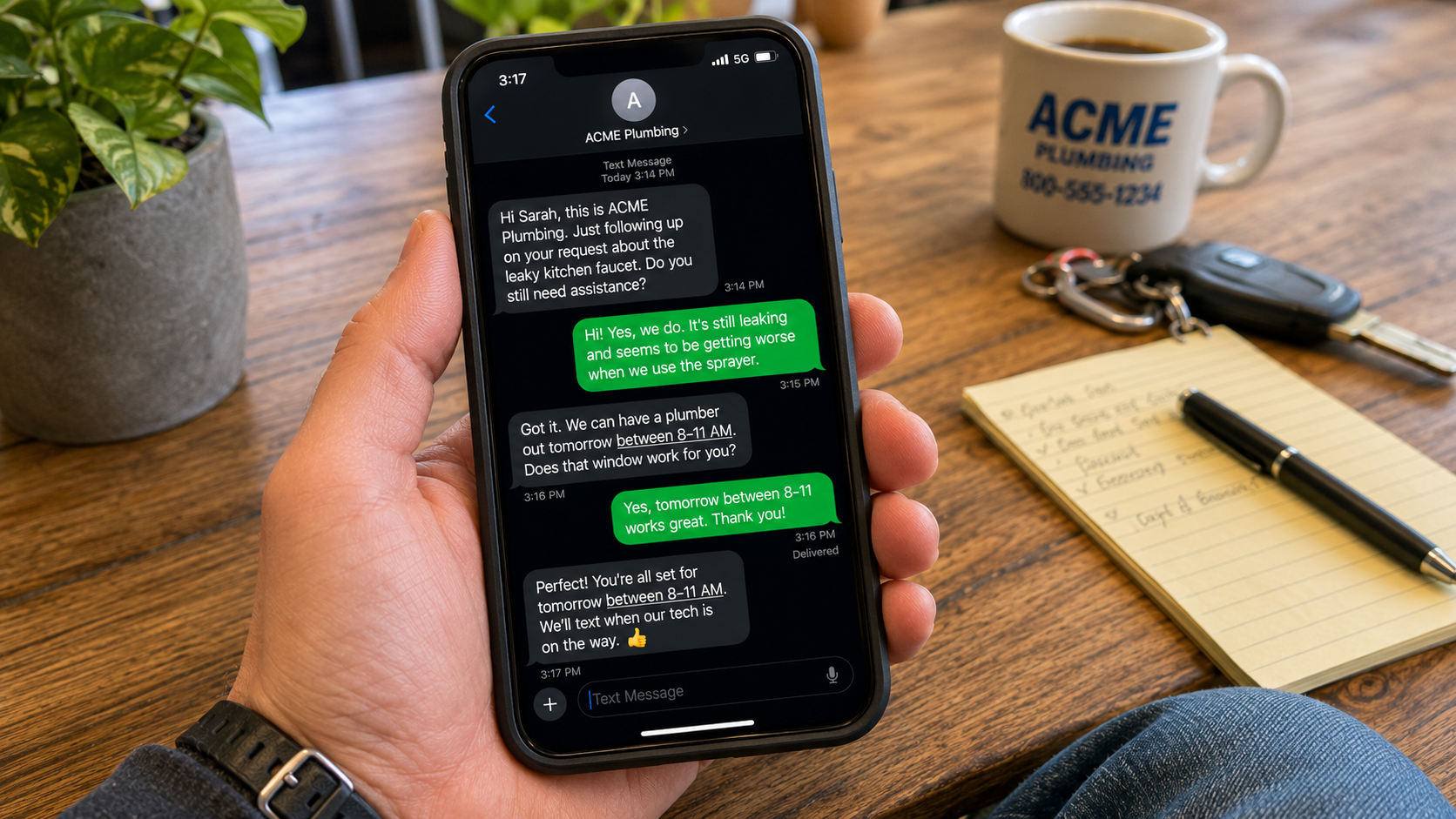
| 2 | 90 minutes | SMS | First name, reference the service they asked about, ask if they still need help. Direct and brief. | Proceed to Touch 3 |
| 3 | Same day, 4-6 hours after contact | Phone call | Live attempt. Leave a voicemail if no answer — reference that you’ve tried to reach them, provide direct number. | Proceed to Touch 4 |
| 4 | Day 2 morning | SMS or email | Check-in. One line. Not a sales pitch. ‘Still happy to help if you need us.’ | Proceed to Touch 5 |
| 5 | Day 5 | Value-add close. A useful tip related to their inquiry, plus a soft offer to schedule. | Mark as unresponsive; remove from active sequence |
Five touches across five days is the right length for local service. Anything beyond day 5 for a local service lead is typically noise. The lead has either re-engaged or resolved the situation. A longer sequence does not convert proportionally more leads. It damages the perception of the business with the leads it does eventually reach.
What the Messages Actually Say
The content of each touch matters as much as the timing. These are the principles that separate messages that convert from messages that annoy.
Touch 1: Acknowledgment, not commitment
The immediate response should confirm receipt without making a promise that can’t be kept. ‘Someone will call you within 30 minutes’ is a commitment. ‘We got your message and will be in touch shortly’ is an acknowledgment. If you miss the 30-minute commitment, the first impression is a broken promise. The acknowledgment sets a reasonable expectation and buys time for Touch 2.
| Touch 1 Template (Immediate SMS) Hi [first name], this is [business name] in [city]. We received your message about [service/general inquiry]. Someone will be in touch with you shortly. Keep it under 3 sentences. No sales language. No links. No emoji.The goal is to confirm the message landed and signal that a human is aware of it. |
Touch 2: The real first contact
Touch 2 at 90 minutes is the highest-value message in the sequence. The lead is still in the window. The message should be personal, reference the specific service they asked about, and ask a direct question that invites a reply.
| Touch 2 Template (90-minute SMS) Hi [first name], this is [name] from [business name].Following up on your inquiry about [specific service].Are you still looking for help with that? Three sentences. First name. Specific service reference. Direct question.The direct question is the most important element — it invites a reply rather than requiring the lead to initiate contact again. |
Touch 3: The live attempt
A phone call matters at this stage because voice converts better than text for local service businesses with higher-ticket work. If no answer, the voicemail should be short: your name, the business, that you’ve tried to reach them, and your direct number spoken slowly. Do not summarize the service or pitch in the voicemail. The goal is to give them a number they can call back without having to search.
Touch 4: The quiet check-in
Touch 4 on day 2 should be the shortest message in the sequence. One line. No pressure. The lead who hasn’t responded yet is either dealing with something, has found a solution, or is letting the inquiry sit. A light touch acknowledges that you’re still available without suggesting they owe you a response.
| Touch 4 Template (Day 2 SMS) ‘Still happy to help if you need us — just reply here or call [number].’ That’s it. No re-introduction. No recap of the service.The lead knows who you are. The goal is to lower the barrier to re-engaging. |
Touch 5: The value-add close
Touch 5 at day 5 is the last active attempt. For local service businesses, the best-performing final touch provides something useful related to the inquiry — a brief answer to a common question about the service, a checklist, or a relevant consideration they may not have thought of. Follow that with by a soft offer.
This works because it gives the lead a reason to open and read the message that isn’t ‘please hire us.’ If the answer to their unasked question is in the email, they engage. If the offer is at the end and presented softly, some percentage of those who engage will convert.
Sequence Variations by Lead Type
The 5-touch framework above is the baseline. The specifics shift based on the type of lead and their likely urgency.
Emergency/urgency leads (pipe burst, AC failure, tree down)
Compress the sequence. Touch 1 goes out immediately and Touch 2 goes out within 30 minutes, not 90. The lead’s problem is acute. Every minute of delay is a minute they’re searching for another option. An emergency sequence has 3 touches in the first 2 hours, not 2 touches across a day.
Quote request / planned work leads
Spread the sequence. A homeowner who submitted a quote request for a bathroom remodel is not in emergency mode. They’re gathering estimates. Touch 1 acknowledges receipt immediately. Touch 2 goes out 4-6 hours later with a brief message and a specific question about their project. Touch 3 (phone call) happens on day 2. The sequence can extend to day 7 or 10 because the buying cycle is longer.
Re-engagement leads (old contacts who haven’t booked)
A different sequence entirely. A lead who contacted you 60 days ago and went cold needs to be re-engaged with a reason, not a reminder. A seasonal hook (‘with fall coming, now is a good time to get your system checked before the cold hits’), a new offer, or a relevant piece of information gives them a reason to reply that isn’t ‘remember me?’
| Emergency leads need a compressed sequence measured in minutes. Planned work leads need a spread sequence measured in days. Using the same sequence for both is the most common follow-up mistake local service businesses make. |
The Automation Piece: What It Actually Does
The sequence above works. The reason most local service businesses don’t run it is that it requires a person to remember to send each message at each timing interval, while also running jobs, answering calls, and managing everything else that happens during a workday. Marketing automation solves this by triggering each touch automatically when a specific condition is met.
When a form is submitted or a missed call is logged in your CRM, the sequence starts automatically. Touch 1 goes out immediately. Touch 2 fires 90 minutes later. Touch 3 creates a task for a live call attempt. Touch 4 fires on day 2. Touch 5 fires on day 5. No one has to remember. No lead falls through because the afternoon was busy.
The other thing automation does is stop the sequence when the lead responds. A lead who replies after Touch 2 should not receive Touch 3, 4, and 5 as if they hadn’t. A basic CRM with sequence logic pauses or ends the automation when a reply is received or a deal status changes. This is what separates a functional follow-up system from one that annoys leads who have already engaged.
| What Automation Requires to Run This Sequence A CRM that captures leads from forms, missed calls, and other entry points SMS capability integrated into the CRM (most modern systems include this) Sequence logic that can trigger on events and pause on replies A direct call task or notification for Touch 3 Email capability for Touch 5 Business Automation Suite (the CRM 1-FIND uses for client automation) handles all of the above and is purpose-built for local service business follow-up workflows. |
Measuring Whether the Sequence Is Working
Three metrics tell you whether your follow-up sequence is producing results:
- Reply rate by touch. What percentage of leads reply after each touch? If Touch 1 gets a 40% reply rate and Touch 2 gets 25%, that’s a healthy sequence. If Touch 1 gets 5% and Touch 2 gets 3%, the message content or timing is off.
- Lead-to-booked rate. Of all leads that entered the sequence, what percentage eventually booked a job? This is the primary metric. Compare it to your rate before the sequence was running. If the rate improved, the sequence is working. If it didn’t, the sequence needs adjustment.
- Time-to-first-contact. How quickly is your automated Touch 1 going out? If Touch 1 is taking more than 5 minutes to trigger, there’s a configuration problem. The speed of Touch 1 determines the window you’re operating in for Touch 2.
A sequence running well on all three metrics is compounding revenue from leads that were previously going cold. A sequence that’s underperforming on reply rate usually has a content problem. One underperforming on lead-to-booked rate usually has a qualification problem: the leads entering the sequence aren’t the right leads.
| Want a follow-up sequence built for your Tri-Cities service business?1-FIND builds and configures automated follow-up sequences for local businesses in Johnson City, Kingsport, Bristol, and across the Tri-Cities. We’ll set up the sequence, integrate it with your existing intake process, and make sure it stops automatically when a lead responds. |