Generic ranking factor posts list 200 signals weighted by industry survey. In 37615, three variables account for most of the movement available to a home services contractor: review velocity relative to direct competitors, proximity management across a three-city market spanning two states, and content depth against a field that is technically weak by measurable data.
The 2026 Tri-Cities Home Services Digital Visibility Study audited 75 HVAC, plumbing, electrical, roofing, and tree service companies across Johnson City, Kingsport, and Bristol in May 2026. The data quantifies exactly where competitors in this specific market are strong, where they’re weak, and which optimization signals produce the most movement given the competitive conditions here, not in Nashville, not in Charlotte, not in some survey of 1,400 SEO professionals.
That specificity matters. The signals that move a Johnson City HVAC company from position 4 to position 1 in the Map Pack are not the same signals that determine national brand rankings in saturated metros. This post covers what actually drives local rankings in 37615 and the surrounding Tri-Cities market, grounded in the actual competitive conditions that exist here.
| The signals worth optimizing in 37615 are not the same ones worth optimizing in Nashville. Market-specific ranking factor analysis beats industry survey lists every time. |
Why the Tri-Cities Market Requires Its Own Local SEO Ranking Factors Analysis
The Tri-Cities is not a standard single-city market. Johnson City, Kingsport, and Bristol are three distinct cities spread across roughly 25 miles of Northeast Tennessee and Southwest Virginia, with Washington, Sullivan, and Carter counties creating separate geographic contexts for local search. A business physically located in 37615 (Gray/Johnson City northeast) is approximately 22 miles from central Bristol.
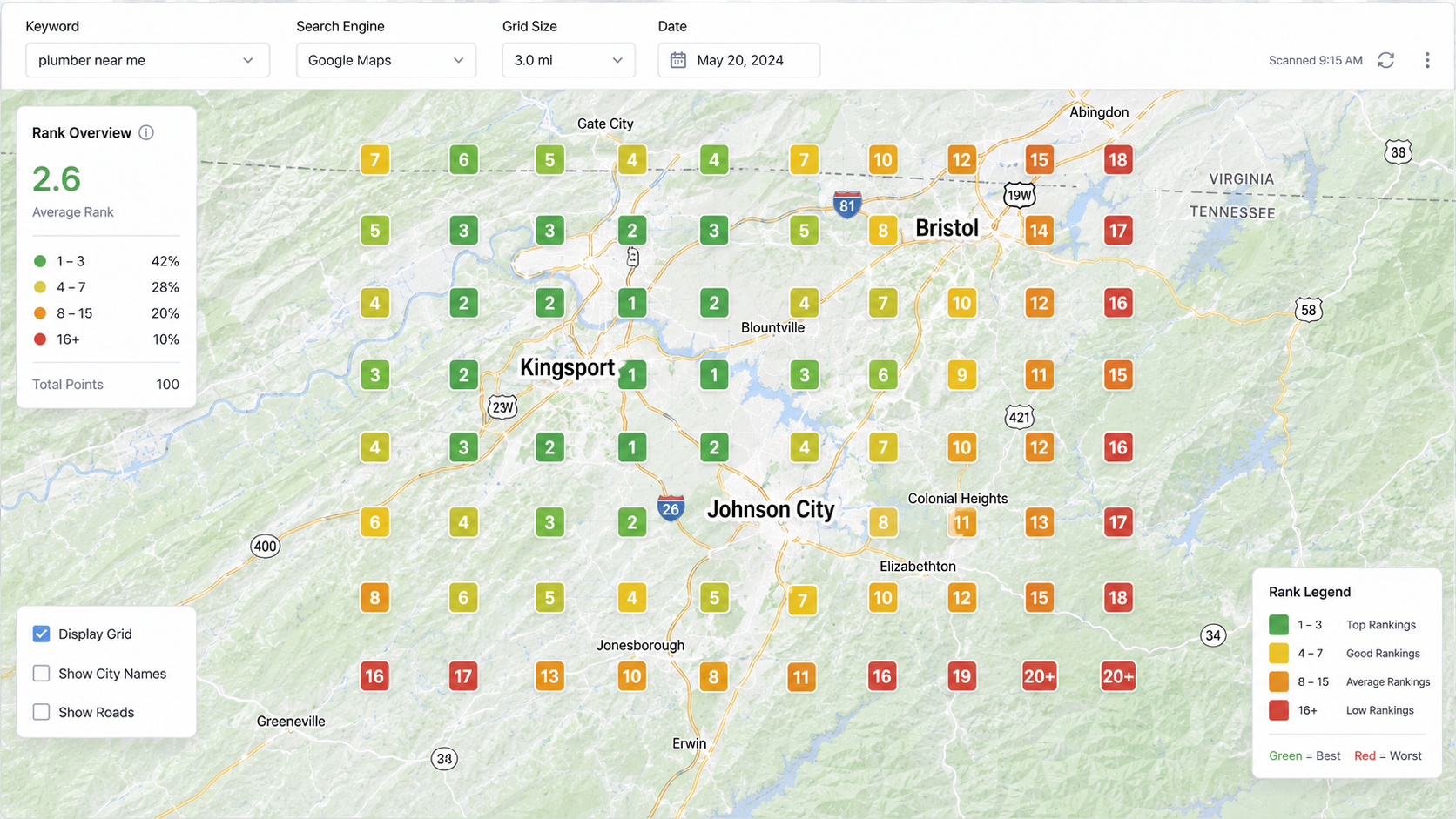
Google’s local algorithm weights proximity heavily. That 22-mile distance means a business in 37615 competing for Bristol searches faces a fundamentally different proximity equation than the same business competing for Johnson City searches. The Tri-Cities market effectively requires thinking about three distinct competitive zones, each with its own proximity dynamics.
The study data reflects this distribution. Of the 75 audited entries, 22 were based primarily in Johnson City, 23 in Kingsport, and 5 in Bristol proper, with 19 regional operators serving the broader market without a single-city anchor. That geographic spread means a search for ‘HVAC repair’ from different points in the Tri-Cities produces materially different Map Pack results from the same pool of competitors.
| Tri-Cities Geographic Context for Local SEO Johnson City: Washington County, TN. Largest population center. Lowest average CVS (70.1) in the 2026 study. Kingsport: Sullivan County, TN. Highest average GBP score (86.5) in the study. Bristol: Split between TN and VA. Highest average CVS (76.7) — smaller competitive set. Gray/37615: Northeast Johnson City suburb, Washington County. Strong proximity for JC east/Gray searches; 20+ miles from Bristol. Elizabethton: Carter County. Less studied; represents an underserved outlying market. Key implication: a single GBP and website cannot serve all three cities equally. Proximity weighting means location pages, service area configuration, and city-specific content matter more here than in a single-city market. |
The Three Factors That Actually Move Rankings in This Market
Factor 1: Review Velocity Relative to Your Direct Competitors
Review count varies dramatically by trade in the Tri-Cities. Plumbing companies average 602 reviews per profile. HVAC averages 479. Tree service averages 82. Roofing averages 77. Those numbers are not the benchmark — your direct trade competitors in your specific city are the benchmark.
An HVAC company in Johnson City competing against three other HVAC companies all in the 200-350 review range needs a different review strategy than one in a roofing market where the leader has 90 reviews. The absolute count matters less than the relative count against the businesses sharing your Map Pack.
Velocity matters more than count because Google uses review recency as an active business signal. A business with 400 reviews and the most recent from 11 months ago is sending a different signal than a business with 180 reviews and 8 in the last 90 days. In a market where the average star rating is 4.81 across 70 profiles (almost no differentiation), review volume and recency are the primary signals that separate Map Pack positions.
The 2026 study found that 28 of 70 profiles with available data (40%) had fewer than 50 reviews. In a market where plumbing operators have 500+, this is a significant gap in lower-performing trade categories. A tree service or roofing company in Johnson City that builds to 150 reviews with consistent monthly velocity is in the top tier of its trade category in this market, not just average. The review generation mechanics that produce this velocity require a systematic ask after every completed job, not periodic campaigns.
Factor 2: Proximity Management Across Three Cities
Because the Tri-Cities is a distributed market, proximity weighting creates a strategic problem for businesses based in one city trying to capture searches in another. A Johnson City business ranks well for Johnson City searches. For Kingsport searches 15 miles north, the proximity signal weakens. For Bristol searches 22 miles further, it weakens more.
The optimization response is threefold. First, service area configuration in Google Business Profile. A business that serves all three cities needs to reflect that in its GBP service area settings, not just its physical location city. Second, dedicated city location pages on the website. A page specifically about HVAC service in Kingsport, with content that references Kingsport context, tells Google that this business operates in Kingsport — reinforcing the service area signal with on-page evidence. The third lever is, review content that mentions cities. When customers in Kingsport mention ‘Kingsport’ in their reviews, that geo-specific language builds a connection between the business and that market that supplements the proximity signal.
The study found that the 19 regional Tri-Cities operators (those without a single-city anchor) averaged a CVS of 71.4 and included several of the study’s top performers. These operators had built content footprints, review profiles, and service area configurations that reflected the full market rather than a single city. That approach produces rankings across the geography, not just around the physical location.
Factor 3: Content Depth Against a Technically Weak Field
The average Website Health Score across 75 audited businesses was 65.8. The average mobile Lighthouse performance score was 65.0. Only 52% had LocalBusiness schema. Only 6.7% had FAQ schema. Fifteen percent had configurations that could make their sites invisible to Google entirely.
This is a weak competitive field by technical standards. In Nashville, Atlanta, or Charlotte, competing for home services rankings means going up against companies with high-budget SEO agencies, sophisticated content strategies, and technically optimized websites. In the Tri-Cities, you’re competing against a market where the average website scores 65.8 out of 100 and 13% of competitors may not be indexed at all.
Content depth is achievable here in a timeline that would be unrealistic in a saturated metro. A roofing company that publishes eight well-structured service and FAQ pages targeting Johnson City, Kingsport, Bristol, Elizabethton, and related query types will have more topical authority in the Tri-Cities roofing market than all but a handful of competitors within 6-9 months. The ceiling on topical authority in this market is low enough to reach.
| In the Tri-Cities, a business with a technically sound website, consistent review velocity, and dedicated city location pages is in the top tier of almost any trade category. The bar is that achievable. |
The Full Ranking Factor Breakdown for 37615
This is the complete weighting framework based on BrightLocal’s Local Search Ranking Factors research applied to the specific competitive conditions documented in the 2026 Tri-Cities study. The ‘Tri-Cities Reality’ column reflects what is actually true in this market, not generic advice.
| Ranking Factor | Weight | Tri-Cities Reality (2026 Study) |
| GBP signals (category, completeness, posting, photos) | High | Avg GBP score 82.8 — market has invested here. Differentiation requires specificity: subcategory selection and attribute accuracy, not just profile completeness. |
| Review signals (count, recency, velocity, responses) | High | 4.81 mean rating leaves no room to differentiate on stars. Count ranges from 1 to 3,690. Velocity is the primary lever for position movement in all five trades. |
| Proximity to searcher | High | In a 3-city market spanning 25 miles, proximity is managed through SAB configuration, city location pages, and review geo-language, not just physical location. |
| On-page signals (title tags, H1, city+service content) | Medium-High | Average website score 65.8. On-page basics are underinvested across the market. City-specific page structure produces outsized gains against this competitive baseline. |
| Schema markup (LocalBusiness, Service, FAQ) | Medium-High | 52% LocalBusiness, 6.7% FAQ. The gap is wider here than national averages. FAQ schema is the single most underutilized structured data type in the Tri-Cities. |
| Technical SEO (crawlability, HTTPS, speed, canonicals) | Medium | 20% of businesses have critical risk flags. 15% may be partially or fully invisible to Google. Fixing basics produces immediate gains that normal markets don’t offer. |
| Behavioral signals (CTR, calls, direction requests from GBP) | Medium | GBP engagement data is increasingly weighted. Photo views, Q&A interactions, and booking clicks all contribute. Most GBP profiles in this market are passive, not active. |
| Link signals (local citations, editorial links, directories) | Lower | Chamber memberships, local directories, and client attribution links produce geo-specific authority. The bar here is low — consistent basic citation presence outperforms most competitors. |
| Content topical authority (blog, FAQ, related topics) | Lower-Medium | Achievable faster here than in saturated metros. A 6-9 month consistent publishing cadence builds category authority against a field averaging 65.8 website health. |
City-Level Strategy: Where the Opportunity Is Largest
The 2026 study measured CVS, GBP Health Score, and Website Health Score at the city level. Johnson City had the most entries (22) and the lowest average scores. That’s not a coincidence. More competitors, more variance, more room for a well-optimized business to stand out.
| Market | Avg CVS | Avg GBP | Avg Website | Optimization Opportunity |
| Bristol area | 76.7 | 87.0 | 69.6 | Smaller sample; high GBP average means website gap is the lever. Technical fixes produce outsized gains. |
| Kingsport area | 73.5 | 86.5 | 64.8 | Highest GBP scores; website is the biggest gap. Content and on-page improvements produce quick differentiation. |
| Tri-Cities regional | 71.4 | 83.0 | 66.2 | Regional operators with broader footprints. City location pages and review geo-distribution are the primary levers. |
| Johnson City area | 70.1 | 79.1 | 67.3 | Lowest scores on both GBP and CVS. Most entries. Both GBP optimization AND website improvement produce gains. Highest ceiling. |
Johnson City is the highest-opportunity market in the Tri-Cities for a business starting from average. The lowest average GBP score (79.1) means GBP optimization (category specificity, attribute completion, photo quality, Q&A population) produces gains here that wouldn’t be as available in Kingsport where the GBP baseline is already 86.5.
The Ceiling: What Scoring 90+ Would Require
No business in the 75-entry sample scored 90 or above on the Combined Visibility Score. The top score was 89.8, achieved by a multi-trade regional operator with a perfect 100/100 GBP Health Score and 83/100 Website Health Score.
A business targeting 90+ in this market needs all of the following simultaneously:
- GBP Health Score above 90. Perfect or near-perfect profile completeness, a primary category that matches the dominant search intent, all relevant attributes enabled, 200+ reviews with strong recency, and NAP consistency between the GBP and the website.
- Website Health Score above 85. This requires passing LocalBusiness schema, Service schema on key pages, FAQPage schema on informational content, Lighthouse mobile score above 80, HTTPS, canonical tags, and XML sitemap in place. No critical risk flags. None of the 75 audited businesses cleared this bar.
- City location pages for each market served. Each page with enough specific content to signal genuine local relevance, not a template with the city name swapped.
- Review velocity in the top quartile of the trade category. For HVAC, that means approaching 479. For roofing, it means consistently above 77. For tree service, consistently above 82.
- No technical barriers. The 20% of the market with critical risk flags are not competing for the 90+ tier. They’re competing to be indexed at all.
The ceiling is achievable. The top score in the market is 89.8. A business that systematically addresses all five categories above crosses it.
| No business in the Tri-Cities scored 90 or above on digital visibility. The market leader scored 89.8. The ceiling is wide open for a business willing to address both GBP and website systematically. |
The Priority Order for a Business Starting From Average
If your business scores somewhere around the market average (CVS 72.0, GBP 82.8, Website 65.8), the correct sequence of investment is:
- Critical risk flags first. Check robots.txt, noindex directives, and HTTPS status. If any of these are wrong, fix them before anything else. These are the configurations that make everything else irrelevant.
- GBP category and attribute audit. Use the most specific applicable primary category. Enable every relevant attribute. This is a one-time configuration that produces immediate ranking signal improvement.
- Review velocity system. An automated post-job review request that sends within 24 hours of completion. Set it up once, run permanently.
- City location pages. A dedicated page for each city you actively serve. Enough specific content on each to signal genuine local presence.
- Schema implementation. LocalBusiness schema on homepage, Service schema on service pages, FAQPage schema on blog and FAQ content. Given that only 52% of the market has LocalBusiness and 6.7% has FAQ schema, this is a direct competitive gap.
- Content depth cadence. One well-structured post targeting a specific local service query every two weeks. This compounds into category authority faster in this market than in larger metros.
| Want to know where your business stands against the 2026 study benchmarks?1-FIND audits local businesses in Johnson City, Kingsport, Bristol, and across the Tri-Cities against the same five dimensions used in the study — GBP health, website health, technical risk flags, schema, and review profile. Free. Includes a prioritized action list specific to your market position. |