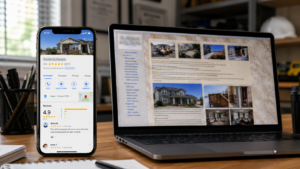

The problem usually isn’t your traffic. It’s what happens in the last ten seconds before someone decides not to call.
If your website is getting visitors but your phone isn’t ringing, the standard advice is to check your call-to-action button, improve your page speed, and make sure you’re mobile-friendly. That advice is accurate. It’s just aimed at the wrong problem.
Most local service business websites that don’t convert aren’t failing because they’re hard to use. They’re failing because something a visitor sees (or doesn’t see) in the final seconds of their visit triggers doubt. That doubt overrides an otherwise willing prospect. They close the tab. They move on to the next result.
The fix for a friction problem is different from the fix for a trust gap. Most websites that aren’t generating calls have a trust gap. This post covers how to tell the difference, and what to actually change.
Table of Contents
| Conversion optimization for local service businesses is mostly trust work, not UX work. The prospect was ready to call. Something stopped them. |
The Distinction That Changes Everything: Friction vs. Trust
Before getting into specifics, the friction-versus-trust distinction is worth understanding, because it determines which fixes will actually move the needle.
Friction problems make it harder to take action. A phone number buried in the footer. A contact form that requires ten fields. A page that loads in eight seconds on mobile. These are real problems, and fixing them helps. But they’re rarely the primary reason a local service business isn’t getting calls.
Trust gaps make someone unwilling to take action even when it’s easy. They landed on your site, they scrolled, they saw your services. Then something created uncertainty. Maybe there were no photos of real people. Maybe the site looked like it was built five years ago and hasn’t been touched since. Maybe your service description was so generic it could belong to any company in the country. Whatever it was, they left not because calling was hard, but because they weren’t sure enough to call.
For local service businesses, trust is the constraint almost every time. The prospect already has urgency, they’re already in buying mode, they already found you. The only thing standing between their visit and their call is confidence that you’re the right choice.
| A Quick Diagnostic Look at your Google Analytics (or Search Console) data: • High impressions, low clicks → title tag / meta description problem, not a website problem • Decent clicks, high bounce rate → page doesn’t match search intent — friction or relevance issue • Good time-on-site, low conversions → almost always a trust gap • Low traffic across the board → SEO or GBP problem, not a website conversion problemMost non-converting local service sites fall into the third category. |
The Seven Trust Gaps That Stop Ready-to-Call Prospects
These are the specific signals that create doubt in the final seconds of a visit. Each one is fixable, and most sites have three or four of them.
1. No human being is visible anywhere on the site
A local service business that shows no photos of its actual people is making a subconscious promise it can’t keep: that the experience of working with them will be as polished and corporate as the website suggests. Prospects know they’re hiring a person, not a logo. When no person is visible, the doubt that forms isn’t ‘who are these people’ — it’s a simpler question: ‘Is this a real local business, or am I about to deal with a call center?’
A photo of the owner or lead technician on the homepage, the about page, or the service pages converts better than any copywriting improvement you can make, because it answers the most important pre-call question before the prospect even thinks to ask it.
2. The phone number isn’t visible in the first screen on mobile
More than half of local service searches happen on mobile devices. On a mobile screen, ‘first screen’ means the content visible before any scrolling. If your phone number requires scrolling to find, a meaningful percentage of mobile visitors will not scroll. They’ll go back to search results.
Your phone number should be tap-to-call, visible above the fold on every page, and styled large enough to read while someone is standing in their kitchen trying to figure out who to call about the water heater.
3. Service descriptions explain what you do instead of who you serve
‘We provide comprehensive HVAC services including installation, repair, and maintenance’ describes services. ‘We fix AC emergencies same-day for homeowners across the Tri-Cities’ describes who you serve and when. The second version tells a prospect immediately whether you’re relevant to their situation. The first forces them to decide based on inference.
Every service page should answer two questions in the first paragraph: who is this for, and what problem does it solve? Generic service descriptions create doubt because they feel like they could belong to any company. Specific service descriptions feel like they were written for the person reading them.
4. The pricing question is completely avoided
Most local service businesses don’t list prices, and that’s usually reasonable: the work varies, the scope varies, the materials vary. But there’s a difference between not listing prices and pretending the pricing question doesn’t exist.
A prospect who has no idea what your service costs and finds no price signals at all on your site is more likely to assume the worst than the best. A simple acknowledgment like ‘Most residential jobs run between $X and $Y depending on scope; we’ll give you an exact quote before any work begins’ doesn’t lock you into a price. It tells the prospect you’re comfortable discussing money, which is itself a trust signal.
5. Reviews are absent, old, or invisible
Reviews are the highest-trust third-party signal available to a local service business. A prospect who finds your website without having already seen your Google Business Profile reviews is forming a first impression with no social proof. If your site doesn’t surface review content, or if the reviews displayed are from 2021, that absence creates doubt.
Recent reviews, displayed prominently and attributed to real people, reduce the trust gap more effectively than any other element on the page. Three specific, recent reviews beat twenty generic five-star ratings.
6. The site looks like it hasn’t been touched in years
Copyright dates in the footer. Blog posts from 2019. A design that predates the current generation of mobile-first layouts. Any of these signals that the business may not be actively maintained, which raises the question of whether the business itself is actively maintained.
A prospect hiring a local service company is making a trust decision about the people they’ll let into their home or business. A website that looks abandoned is a proxy signal for a business that doesn’t pay attention to details. It may be completely unfair, but it’s how prospects read it.
7. No local proof of any kind
A website that could belong to a company anywhere in the country gives local prospects nothing to anchor their trust to. Photos of actual jobs in the Tri-Cities. A service area page that names the specific counties and cities you cover. A mention of the Johnson City Chamber, a local client by name, a before/after from a recognizable neighborhood. Any of these establish that you’re a real local business in a way that generic content doesn’t.
Local proof matters especially because it’s the one signal that national competitors and lead aggregators can’t replicate. A national home services platform can outbid you on Google Ads. It cannot show a photo of a job you completed two streets over from the prospect’s house. Local specificity is a competitive advantage that exists only in your local SEO and website content, and most local service businesses underuse it significantly.
| Local specificity is the one competitive advantage that national platforms can’t replicate. Most local businesses significantly underuse it. |
The Trust Audit: How to Read Your Own Site Like a Prospect
The problem with auditing your own website is that you know too much. You know who you are, you know your reputation, and you fill in the trust gaps automatically when you visit. A first-time prospect fills in nothing.
The most useful audit exercise is to visit your homepage as if you’ve never heard of your business, give yourself 15 seconds, and ask: would I call this company? If the answer requires any prior knowledge of who you are, the site has a trust gap.
For a more systematic review, run your site against this checklist:
|
Trust Signal |
Failing Sign |
Fix |
|
Human presence |
No photos of real people anywhere on site |
Add owner/team photo to homepage hero or about page |
|
Mobile phone visibility |
Number requires scrolling on mobile |
Sticky header with tap-to-call on all pages |
|
Service specificity |
Descriptions could belong to any company |
Name who you serve, what problem you solve, your market area |
|
Pricing signals |
No price context anywhere on site |
Add a starting range or ‘most jobs run $X-$Y’ language |
|
Review visibility |
No reviews on site, or reviews from 2+ years ago |
Embed 3 recent Google reviews with attribution on homepage |
|
Site currency |
Old blog posts, 2022 copyright, dated design |
Update footer date, publish recent content, refresh hero image |
|
Local proof |
No local photos, cities, or client references |
Add job photos with location mentions, named service area |
The One Fix That Beats Everything Else
If you can only do one thing, add a photo of a real person to your homepage above the fold.
This sounds too simple, but the research on trust formation in under-10-second website visits consistently shows that human faces are the fastest trust signal available. A prospect deciding whether to call a local service business is making a judgment call about a person, not an entity. Giving them a face to associate with your business compresses the trust timeline faster than any other single change.
It doesn’t need to be a professional headshot. A photo of you on a job site, in your shop, or with your crew (something that looks real and current) outperforms a polished stock photo every time. Stock photos of smiling contractors in spotless uniforms signal ‘this company uses stock photos,’ which is the same signal as ‘this company doesn’t show you the real thing.’
What This Looks Like in Practice
A local HVAC company in the Tri-Cities area had traffic from search but consistently low call volume. Their site had a professional design, fast load times, and a clear CTA button. Three trust gaps were causing the problem:
- No photos of the actual technicians — just a logo and a hero image of a generic house
- Service descriptions that were entirely generic, with no mention of the specific cities or service radius
- One review displayed on the homepage, dated 18 months prior
Three changes: a photo of the owner and two technicians on the homepage, a service area paragraph naming six specific Tri-Cities communities, and an embedded Google review widget showing the five most recent reviews. Call volume increased within the first 30 days, without any change to traffic or ad spend.
The traffic was never the problem. The trust gap was.
| Traffic without trust is just window shopping. Fix the trust gap first, and the traffic you already have starts converting. |
When the Website Is Actually Fine
Not every non-converting website has a trust problem. Before investing in website changes, it’s worth confirming that the website is actually where the problem lives.
If your website gets very little traffic to begin with, conversion optimization won’t help. The problem is upstream: either your local SEO isn’t driving discovery, your Google Business Profile isn’t generating visits, or both. Fix the traffic problem first, then evaluate conversion.
If your website gets decent traffic and decent calls but you’re still losing jobs at a high rate, the problem may be downstream from the website entirely. Slow follow-up after form submissions and missed calls are two of the most common revenue leaks in local service businesses, and they’re invisible in website analytics. A proper follow-up system recovers leads that your website already generated but your follow-up process dropped.
The diagnosis matters as much as the fix. A trust gap on a low-traffic website is a secondary problem. Fix the traffic first, then the trust. A well-converting website with poor follow-up is a bucket with a hole in the bottom. Adding more water doesn’t help.
| Not sure why your website isn’t generating calls? 1-FIND offers a free website audit for local businesses in the Tri-Cities. We’ll identify the specific trust gaps and friction points on your site, show you what a prospect actually sees when they visit, and give you a prioritized fix list — starting with the changes most likely to move your call volume. |

Before launching 1-FIND Services, Casey spent over a decade living and working in Japan, running a web hosting business and doing high-level corporate translation work. That experience shaped a methodical, detail-first approach to marketing that you don't often find at agencies his size.
His work spans local SEO, AI-driven automation, and conversion-focused web design, areas where technical know-how and strategic thinking have to work together. That combination has made him a go-to resource for business owners trying to compete in an increasingly crowded digital landscape, and has helped establish 1-FIND Services as a recognized agency across the Tri-Cities region, including Johnson City, Kingsport, Bristol, Elizabethton, and Abingdon, VA.
What that looks like in practice:
Local & Organic SEO, getting businesses in front of the people already searching for them
Web Design, building fast, mobile-friendly websites that actually convert visitors into leads
Business Automation, helping companies work smarter with AI-powered tools and CRM integration
Google Business Profile Optimization, boosting local visibility and map presence where it counts
Casey keeps a close eye on search algorithm updates, AI developments, and how user behavior is shifting — because his clients' results depend on it. It's that combination of staying current and keeping things straightforward that defines the way 1-FIND Services operates: honest, results-driven marketing with no fluff.
- Viking Mountain Marketing Joins Forces with 1-FIND SERVICES - September 4, 2026
- Plumber Marketing: How to Fill Your Schedule in the Tri-Cities - August 12, 2026
- Local SEO Ranking Factors: What Google Actually Uses in the Tri-Cities Market - July 28, 2026