Most businesses have a lead generation problem. Or so they think.
The actual problem, for most local service businesses, is different. They’re spending money to generate leads through Google Ads, SEO, social media, word of mouth, and those leads are arriving. Forms are being filled out. Calls are coming in. Inquiries are landing in inboxes. And then, silently, a significant portion of them are evaporating before anyone on the team even knows they existed.
The fix isn’t more marketing spend. It’s plugging the gap between when a prospect makes contact and when your business actually responds. Fix that gap, and the leads you’re already generating start converting at a meaningfully higher rate. Keep ignoring it, and every dollar you spend on acquisition is working against a quiet leak you haven’t measured.
Table of Contents
| You don’t have a lead generation problem. You have a lead retention problem. The leads are arriving. They’re just dying in the gap. |
What’s Actually Happening in a Prospect’s Mind After They Reach Out
When someone fills out a contact form, calls your business, or sends a message through your website, they’re in a specific mental state. They’ve identified a problem or a need. They’ve decided to do something about it. They’ve found you, evaluated you enough to make contact, and taken an action. That’s a significant amount of psychological momentum.
That momentum is fragile. And it has a shelf life measured in minutes, not hours.
Here’s what happens to it over time:
- 0 to 5 minutes: The prospect is fully engaged. They’ve just submitted the form or ended the call. They’re in problem-solving mode. A response right now converts at the highest possible rate.
- 5 to 30 minutes: The momentum is fading. They may have started on something else. A response now still has a good chance, but the opening line of any conversation has to re-establish context.
- 30 minutes to 2 hours: The prospect has likely moved on mentally. They may have contacted a competitor. A response now requires rebuilding intent from scratch.
- 2 hours or more: The lead is cold. They’ve either solved the problem another way, decided it wasn’t urgent, or chosen someone who responded faster. A response at this point may get a reply, but it’s working uphill.
This isn’t a theory. Research from Harvard Business Review found that companies responding to leads within an hour were nearly seven times more likely to have a meaningful conversation than those that waited even 60 minutes. For local service businesses competing against other local options, where the prospect can reach an alternative in two taps, that window is even shorter.
The Five Channels Where Leads Are Slipping Through
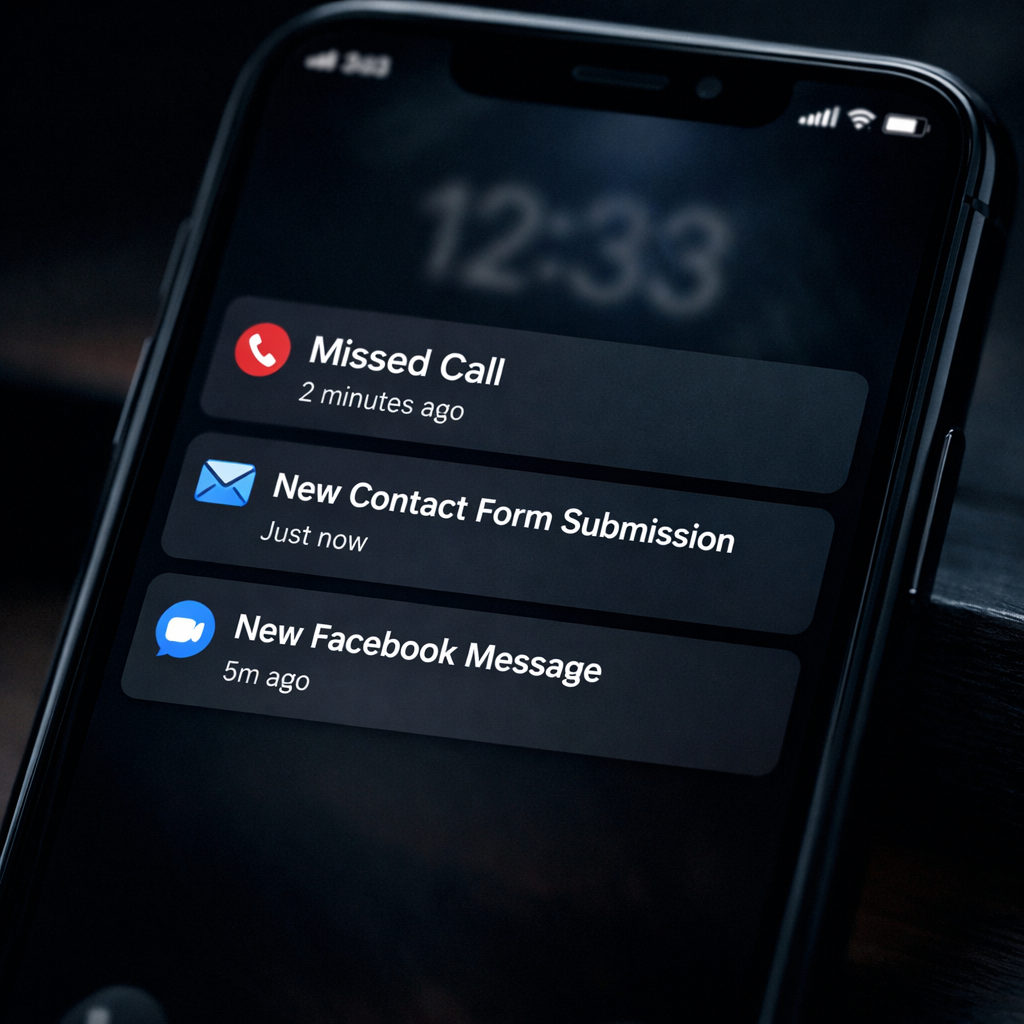
Most business owners think about follow-up in terms of phone calls. But the gap exists across every channel where a prospect can make contact, and most businesses have at least three or four of them running without a consistent response system in place.
1. Contact Forms
Contact form submissions are the most commonly neglected lead source. The form gets filled out, it lands in an email inbox, and it sits there until someone checks that inbox, recognizes it as a lead rather than spam, and decides to respond. In a busy week, that can take hours or days. The prospect submitted the form because they wanted a fast answer; they got silence.
2. Missed Calls
As covered in detail in a previous post on missed calls, a missed call without an immediate automated text response is almost always a lost lead. The caller doesn’t wait. They go back to Google and call the next result. The call log shows a missed call with no note, no follow-up, and no record of whether that person ever called back.
3. Live Chat and Website Messaging
Businesses that install a chat widget and then don’t staff it are creating an expectation they can’t meet. A prospect who opens the chat expecting a quick answer and gets an auto-response saying someone will get back to them in 24 hours is a prospect who just learned this business isn’t as responsive as the chat widget implied.
4. Social Media DMs
For businesses with active social media presences, direct messages are an underestimated lead source. Someone who DMs a business on Facebook or Instagram is often a warmer prospect than someone who fills out a form, because the DM feels more personal and immediate. These messages frequently go unread for hours because no one has set up notifications or a response protocol.
5. Google Business Profile Messages
Google allows prospects to message businesses directly from the search results page. Most local businesses either haven’t enabled this feature or have enabled it and then never check it. A prospect who messages through Google and hears nothing is a prospect who just had their first experience with your business — and it was silence.
| Every channel where a prospect can make contact is a channel where leads can disappear. Most businesses have four or five of them running with no consistent response system. |
The Math: What the Follow-Up Gap Is Costing You
The numbers become uncomfortable when you apply them to your own business. Walk through this:
| Question | Your Number |
| Total inbound leads per week (calls, forms, DMs, messages) | _______________ |
| Estimated % responded to within 5 minutes | _______________ |
| Estimated leads lost to slow response per week | _______________ |
| Average job or contract value ($) | _______________ |
| Revenue lost per week to follow-up gap: | _______________ |
| Revenue lost per year to follow-up gap: | _______________ |
For most local service businesses, the annualized number lands between $30,000 and $150,000. Not because the business is doing something wrong, but because no one built the infrastructure to catch leads that arrive outside of active working hours or during busy periods when the phone goes unanswered and the inbox goes unchecked.
Why This Is a Systems Problem, Not a Staffing Problem
The instinctive reaction to a follow-up gap is to hire someone to handle it, or to tell the existing team to be faster. Neither works reliably.
Hiring someone to monitor and respond to leads requires that person to be available across all channels, at all hours, including evenings and weekends when a significant portion of inquiry traffic arrives. That’s expensive, and it doesn’t scale.
Telling the existing team to be faster works until the next busy period, the next staff change, or the next week when three things happen at once and the inbox falls behind again. Manual processes are as reliable as the least reliable day your team has.
The businesses that solve the follow-up gap permanently solve it with systems, not people. A properly configured automation setup does several things no human can replicate consistently:
- It responds instantly, at any hour, on any day, without exception
- It doesn’t have a bad day, a busy week, or a gap in coverage during lunch
- It creates a logged record of every inbound contact and every response
- It routes leads to the right person with the right context, without anyone having to sort through an inbox
- It follows up again if the first message doesn’t get a response, on a schedule you control
This is what a business automation and CRM system actually does in practice. Not theoretical efficiency gains. A concrete, measurable reduction in leads lost to the follow-up gap, running without anyone on your team having to remember to do anything.
What a Proper Follow-Up Sequence Looks Like
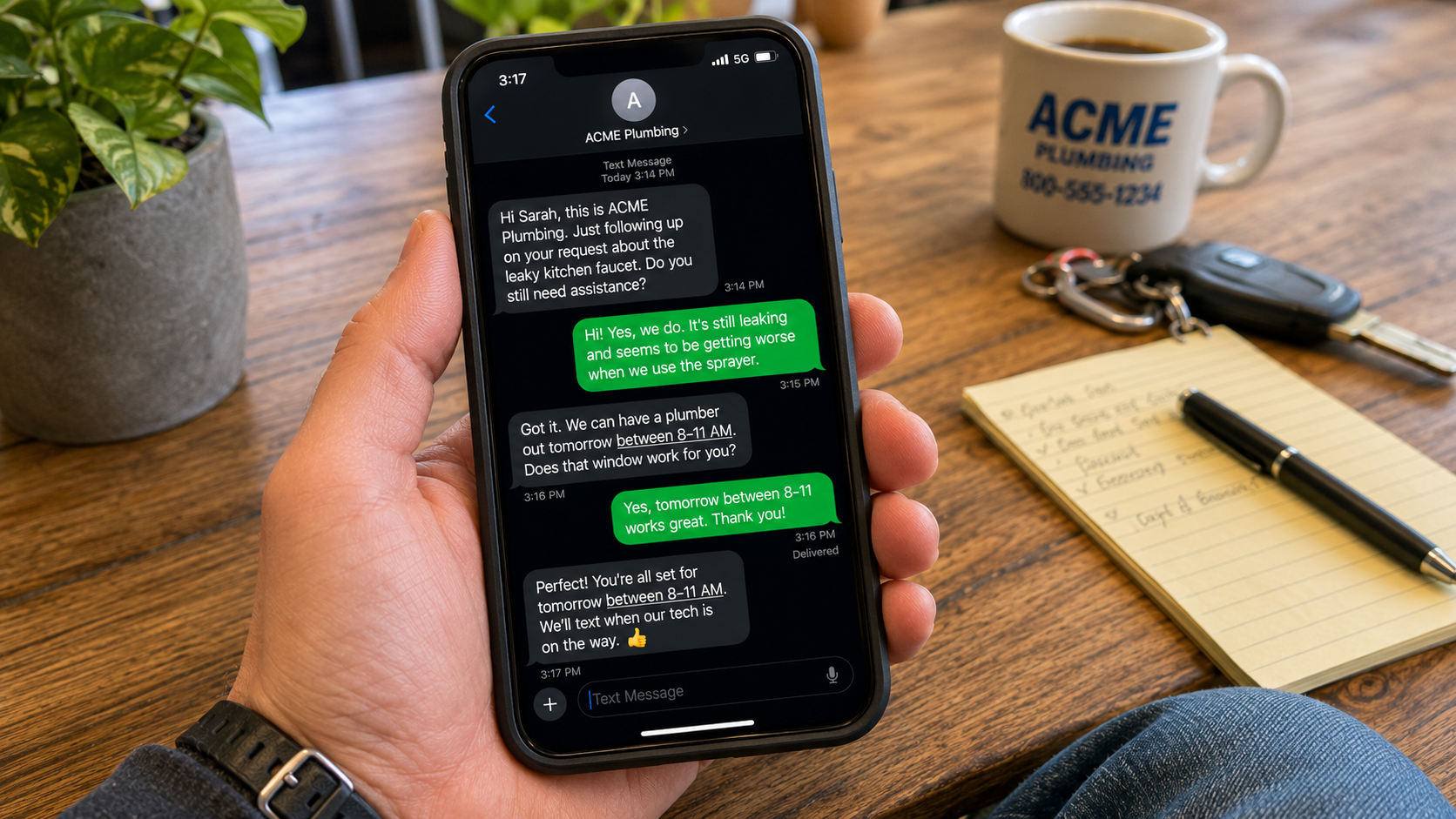
The goal of automated follow-up isn’t to replace a human conversation. It’s to bridge the gap until a human conversation is possible, in a way that keeps the lead warm and the prospect feeling acknowledged.
Here’s what a well-designed sequence looks like for a local service business, from first contact to conversion:
|
Timing |
Action |
What It Does |
|
Immediate |
Automated text or email |
Acknowledges the contact instantly. Keeps the prospect in your ecosystem rather than sending them back to Google. |
|
2 minutes |
Internal notification |
Alerts the right team member with the lead’s details and contact info so they can follow up personally as soon as they’re free. |
|
1 hour |
Second automated touch |
If no human response yet, a brief follow-up: ‘We want to make sure we connect with you — what’s the best time to reach you?’ |
|
24 hours |
Third touch if no reply |
A final automated follow-up, low-pressure, that keeps the door open without being aggressive. |
|
Human response |
Personal conversation |
By this point the prospect knows you’re attentive, responsive, and professional. The human conversation starts from a warmer position. |
The specifics vary by business type and service. A dental practice runs a different sequence than a home services company. But the underlying structure is the same: instant acknowledgment, internal routing, graduated follow-up, human handoff.
The Difference Between Automated Follow-Up and Spam
The concern most business owners raise when this topic comes up: won’t automated messages feel impersonal or annoying?
The honest answer is that poorly written, poorly timed, high-volume automated messages absolutely feel that way. But that’s a content and cadence problem, not an automation problem. The distinction comes down to three things:
- Relevance: An automated text that says “Hi, we just missed your call, what can we help you with?” is relevant because it’s responding to a specific action the prospect just took. An automated email blast to a cold list is not relevant. One feels like good service. The other feels like spam.
- Timing: Two to three follow-up touches over 24 hours is attentive. Six messages over the same period is aggressive. The right sequence respects the prospect’s time and attention rather than overloading it.
- Tone: Automated messages that sound like templates read like templates. Messages written in the voice of your actual business, brief, conversational, and specific to the context, don’t read as automated even when they are.
The goal is for the prospect to feel like your business noticed them and responded quickly, not to feel like they’ve been enrolled in a marketing sequence. That distinction is entirely achievable with the right setup.
| Done right, automated follow-up doesn’t feel like automation. It feels like a business that actually pays attention. |
Building a Follow-Up System: Where to Start
If your current follow-up process is inconsistent, here’s the priority order for building something that actually holds:
|
# |
Step |
What It Means in Practice |
|
1 |
Audit your channels |
List every place a prospect can contact you: phone, forms, chat, social DMs, GBP messages. You can’t fix a gap you haven’t mapped. |
|
2 |
Missed call text-back first |
This is the fastest win. If you’re missing calls without a text-back response, fix this before anything else. It takes less than a day to implement. |
|
3 |
Contact form automation |
Every form submission should trigger an immediate acknowledgment email or text. No exceptions, no delays. |
|
4 |
Internal lead routing |
Every inbound lead should create a notification to the right person with the context they need to follow up. Not an email to a shared inbox — a direct alert. |
|
5 |
Graduated follow-up sequence |
Build a 24-hour follow-up sequence for leads that don’t respond to the first touch. Two to three messages, spaced out, low-pressure. |
|
6 |
CRM integration |
All of this should feed into a single system where every lead is logged, every interaction is tracked, and nothing falls through because it was in the wrong inbox. |
The businesses that execute this sequence reliably don’t just convert more leads. They also generate better reviews, stronger referrals, and more repeat business, because the first experience a prospect has with the business is one of competence and attention. That impression carries through the entire relationship. If you want to see what this looks like implemented for a local service business, our Business Automation Suite covers all six steps, set up and running without your team having to manage the pieces manually.
Stop Losing Leads You Already Paid to Generate
At 1-FIND SERVICES, we build follow-up systems for local service businesses in the Tri-Cities that catch leads across every channel, respond instantly, and route them to the right person with the right context. If you’re not sure how much your current follow-up gap is costing you, we offer a free audit that maps your inbound channels and identifies exactly where leads are slipping through.
No pitch, no pressure. Just a clear picture of what’s happening between the moment a prospect makes contact and the moment your team finds out about it.