Search changed. Most businesses haven’t caught up yet.
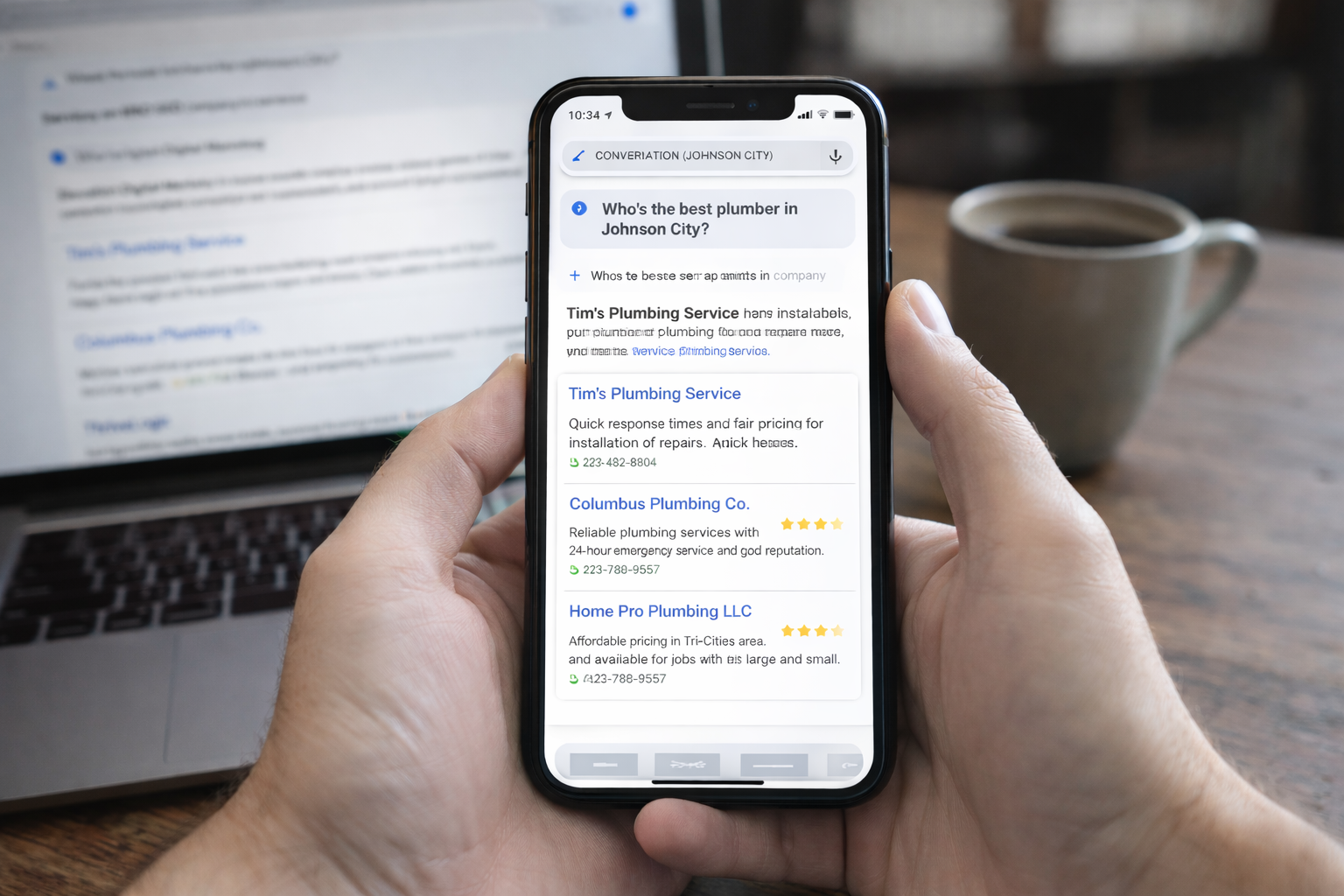
If you’ve used Google recently, you’ve probably noticed something different at the top of the results page: a block of AI-generated text that answers your question before you ever click a link. That’s Google’s AI Overview. It’s pulling from websites across the web, synthesizing an answer, and presenting it directly, often without the user needing to visit any of the sources it drew from.
ChatGPT, Perplexity, and other AI tools do the same thing at a larger scale. Someone types ‘who’s the best SEO company in Johnson City’ or ‘what should I look for in a local accountant’ into one of these tools, and it produces an answer, citing some businesses, ignoring others, based on criteria most business owners don’t know exist.
Answer Engine Optimization — AEO — is the practice of strengthening the signals AI systems rely on to decide what to cite. It builds directly on SEO, but the target is different. SEO aims to rank you in traditional search results. AEO aims to build the signals — topical authority, structured data, entity consistency — that make citation in AI-generated answers more likely. For local businesses, both matter, and the gap between businesses that are optimized for this shift and businesses that aren’t is growing. 1-FIND provides Johnson City SEO and AEO services.
Table of Contents
| SEO gets you ranked in search results. AEO gets you cited when an AI answers a question. The underlying work overlaps, but the target is different. |
The AI Search Surfaces That Matter for Local Businesses
Not all AI answer engines are the same, and they don’t all behave the same way for local business queries. Understanding which surfaces matter helps you prioritize where to focus.
Google AI Overviews
Google’s AI Overview appears at the top of search results for a growing percentage of queries, particularly informational and comparison searches. For local service businesses, it most commonly appears on questions like ‘how do I choose a local SEO company’ or ‘what does a title company do,’ not on pure transactional searches like ‘plumber near me,’ where the Map Pack still dominates.
Google AI Overviews pull from pages that are already ranking in traditional search. If your content doesn’t rank for a query, it won’t appear in the AI Overview for that query either. Strong traditional SEO is the prerequisite.
ChatGPT and GPT-powered tools
ChatGPT is increasingly used as a research and recommendation tool. When someone asks ‘what should I look for in a digital marketing agency in Tennessee,’ ChatGPT draws from its training data and, for users with web browsing enabled, from live search results. Businesses that appear prominently in authoritative sources (their own website, local directories, review platforms, news mentions) are more likely to surface as recommendations.
Perplexity
Perplexity is a search tool built specifically around AI-generated answers with citations. Unlike ChatGPT, it always cites its sources inline, which means appearing as a cited source is visible and attributable. Perplexity tends to favor pages with clear, direct answers to specific questions, structured content, and strong topical authority on the subject being queried.
Voice search and smart assistants
Siri, Alexa, and Google Assistant answer spoken queries by pulling from a single source rather than displaying a list of results. The business or page that gets cited is the one whose content most directly and clearly answers the specific question asked. For local queries (‘best HVAC company near me’), voice results depend heavily on Google Business Profile data and local search rankings.
| Which Surface Matters Most for Your Business? Local transactional queries (‘plumber near me’, ‘dentist Johnson City’): Google Map Pack still dominates. GBP optimization is the priority. Informational and comparison queries (‘how to choose a CPA’, ‘what does SEO cost’): Google AI Overviews and Perplexity. Content quality and structure are the priority. Research and recommendation queries (‘best marketing agency in TN’, ‘who should I use for title insurance’): ChatGPT and Perplexity. Brand authority and third-party mentions matter most. Voice queries: Google Assistant. GBP accuracy and featured snippet-eligible content. |
How AI Answer Engines Decide What to Cite
The criteria AI systems use to select sources are not public, and they differ across platforms. But the patterns that emerge from studying what gets cited consistently point to the same underlying qualities.
Topical authority
AI systems favor sources that have demonstrated depth on a topic, not just a single page about it. A website with one generic ‘SEO services’ page is less likely to be cited on an SEO question than a site with multiple well-developed pages covering different aspects of SEO, backed by a blog that addresses specific questions in detail. This is the same topical authority that drives traditional SEO rankings, but it’s more critical for AI citation because the systems are explicitly trying to find the most authoritative source, not just a relevant one.
Clear, direct answers to specific questions
AI systems retrieve answers to questions. Pages structured around questions and answers, with clear headings, concise explanations, and direct responses to the query, are easier for AI to extract usable content from than pages written as flowing prose with no structural signals. An FAQ section on your service page that asks and answers the specific questions your prospects type is direct input for AI retrieval systems, not just good UX.
Schema markup and structured data
Schema markup is code added to your website that tells search engines and AI systems exactly what type of information each piece of content represents. FAQ schema, LocalBusiness schema, Service schema, and Review schema all provide structured, machine-readable signals that AI retrieval systems can parse without guessing. A page with proper schema is easier to cite correctly than one without it.
Entity recognition
AI systems work by recognizing entities: people, places, businesses, services, concepts, and the relationships between them. Your business being consistently described in the same terms across your website, your GBP, your directory listings, and third-party mentions makes it easier for AI systems to confidently identify your business as the relevant entity for a given query. Inconsistency across sources creates ambiguity that works against citation.
Third-party mentions and citations
AI systems weigh how often and where a business is mentioned outside its own website. Reviews on Google, Yelp, and industry directories. Coverage in local news or business publications. Links from other credible sites. These external signals tell AI systems that the business is real, established, and recognized by sources other than itself. A business that only exists on its own website is harder to cite confidently than one that appears consistently across multiple credible sources.
| AI systems cite sources they can confidently identify as authoritative. That confidence comes from consistency, depth, and third-party recognition: the same signals that drive traditional SEO. |
AEO vs. SEO: What’s Different and What Overlaps
The relationship between AEO and SEO is close enough that treating them as entirely separate disciplines creates unnecessary complexity. Most of what makes a page rank well in traditional search also makes it more likely to be cited by AI systems. The differences are in emphasis and in a few specific techniques.
| Traditional SEO Focus | AEO Additional Focus |
| Ranking for keyword queries | Being cited in answer summaries |
| Page-level optimization (titles, meta, H1) | Question-and-answer content structure |
| Backlinks for authority | Third-party mentions and entity recognition |
| Site speed and technical health | Schema markup and structured data |
| Topical authority through content depth | Direct, extractable answers to specific questions |
| Google Business Profile for local | Consistent entity signals across all platforms |
| Review quantity and recency | Review content quality (specific language AI can cite) |
The practical implication: if your SEO fundamentals are weak, AEO work won’t compensate for them. Fix the foundation first, then layer in the AEO-specific elements.
What Local Businesses Need to Do Differently
For a local service business, AEO is less about radical changes to your strategy and more about specific additions to what you’re already doing for SEO. The businesses that will be well-positioned in AI search results over the next two to three years are the ones that start these practices now, while most competitors are still treating AI search as something to worry about later.
Structure your service pages around questions
Every service page on your website should anticipate the specific questions a prospect researching that service would ask and answer them directly. Not in a separate FAQ section bolted on at the bottom, but woven into the page structure itself, with subheadings that mirror the actual question phrasing. ‘How much does SEO cost in Johnson City?’ as a subheading, followed by a direct, specific answer, is more extractable by AI than a paragraph that mentions pricing in passing.
Add FAQ schema to your key pages
FAQ schema is structured code that marks up question-and-answer pairs in a format AI systems can parse directly. It’s one of the clearest signals you can send that a page contains direct answers to specific questions. Combined with LocalBusiness schema and Service schema, it gives AI retrieval systems a clean, machine-readable picture of what your business does, where it operates, and what questions it answers.
Build topical depth, not just page coverage
A website that has one page per service and nothing else doesn’t demonstrate topical authority to an AI system. The blog content you publish over time, the specific questions you answer, the local context you provide, all of this accumulates into a signal that your site is the right source to cite on a given topic. This is why a consistent content strategy compounds over time in ways that individual page optimizations don’t.
Pursue third-party mentions deliberately
AI systems weight external validation. A mention in the Johnson City Press, a feature in a local business publication, a detailed case study on a client’s website, an interview on a local podcast. All of these are harder to manufacture than on-site content, but they carry more weight precisely because they come from sources other than you. Even consistent, detailed responses to questions in online communities or forums build the kind of distributed presence that AI systems recognize.
Optimize your review content, not just your review count
AI systems can read and cite review content, not just star ratings. A review that says ‘Casey at 1-FIND completely rebuilt our local SEO presence and we went from nowhere in search results to the top of the Map Pack in Johnson City within three months’ is more useful to an AI system than ‘Great service, highly recommend.’ When requesting reviews, give clients a prompt that encourages specific, detailed language about what the service accomplished.
The Local Business AEO Checklist
If you’re starting from scratch on AEO, work through these in order:
- Audit your existing schema. Check what structured data is already on your site. Most WordPress sites with Rank Math or Yoast have some schema, but it’s often incomplete or misconfigured. LocalBusiness, Service, and FAQ schema should all be present and accurate.
- Add FAQ schema to your top service pages. Start with the pages that get the most impressions in Google Search Console. These are the pages that are already close to ranking and will benefit most from additional AI-extractable signals.
- Rewrite at least one service page around questions. Pick your highest-priority service page and restructure it so the subheadings are questions that prospects actually ask. Answer each one directly and specifically.
- Audit your entity consistency. Check that your business name, address, phone, and service descriptions are consistent across your website, GBP, and major directories. Inconsistency is ambiguity, and AI systems don’t cite ambiguous entities confidently.
- Start building topical depth. The blog posts you publish over the next 12 months are the topical authority signal that will determine how AI systems understand your expertise. Each post that answers a specific, relevant question adds to that signal.
- Pursue one external mention per month. A guest post, a local news feature, a podcast appearance, a case study on a client’s site. The goal is consistent presence in credible external sources, not viral coverage.
| The businesses that will show up in AI search results in 2026 and beyond are the ones building topical authority and structured content now. It compounds slowly, then quickly. |
What Not to Do
A few specific mistakes are worth flagging because they’re common responses to the AEO conversation that don’t actually help.
- Publishing thin AI-generated content at scale. AI answer engines are trained to recognize and discount low-quality, undifferentiated content. A blog with 50 posts that all sound the same and say nothing specific does less for topical authority than 10 posts with real depth and local specificity. Quality over volume.
- Treating AEO as a separate workstream from SEO. The businesses that manage these as parallel projects create redundant work and miss the compounding benefits of an integrated approach. AEO is an extension of SEO, not a replacement for it.
- Waiting for AI search to ‘settle down’ before acting. The businesses ranking well in AI search results in two years are building their authority now. Waiting for the landscape to stabilize means starting from behind when it does.
- Optimizing only for ChatGPT or only for Google. The surfaces are different, the citation criteria overlap substantially, and a strategy that builds genuine authority tends to perform across all of them. Chasing one platform’s specific behavior often produces brittle results.
| Want your business to show up in AI search results?1-FIND offers SEO and AEO services specifically for local businesses in the Tri-Cities. We handle the technical schema, content structure, and topical authority work that gets you cited in Google AI Overviews, Perplexity, and beyond — alongside traditional local search rankings. |