Review count is the strongest predictor of AI search visibility we found in our 2026 Tri-Cities AI Search Visibility Study. Businesses with 100–199 Google reviews were mentioned by ChatGPT and Perplexity 79% of the time. Businesses with fewer than 20 reviews were mentioned 11% of the time. If you’re not actively generating reviews, you’re losing visibility on every platform that matters, not just Google Maps.
The biggest obstacle to review volume isn’t unhappy customers. It’s friction. A customer who’s willing to leave a review will often skip it if it takes more than a few taps to find your listing. QR codes and NFC plates remove that friction.
QR codes: the simple version
A QR code on your business card, invoice, or countertop display takes a customer straight to your Google review form. No searching for your business name, no typing.
To set one up:
- Open your Google Business Profile, go to the “Get more reviews” section, and copy your review link.
- Paste that link into a QR code generator (QR Code Monkey and QR Code Generator are both free) to create your code.
- Add the code to your business card, invoice, or a small countertop sign.
NFC plates: the tap-to-review version
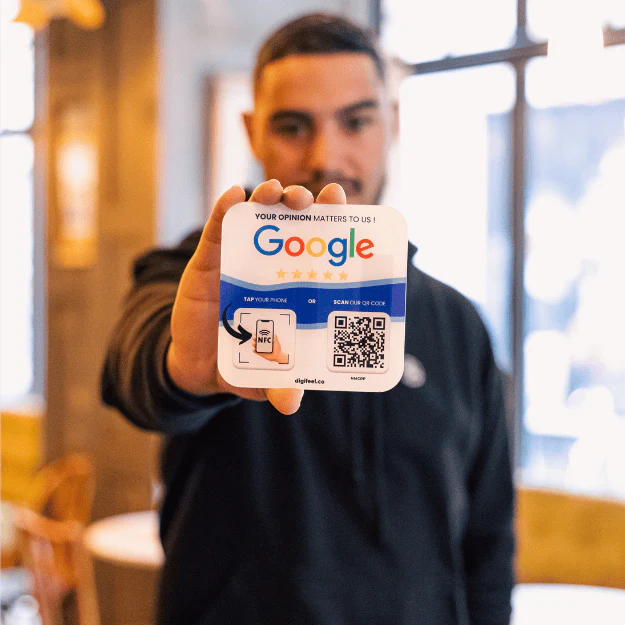
NFC plates do the same thing without requiring the customer to open a camera app. They tap their phone against the plate and land directly on your review page. We’ve vetted a few vendors and use [Digifeel](— use your existing affiliate link here —) for our own clients (disclosure: that’s an affiliate link, and code 1-FIND gets you 10% off if you want to try them).
Setup takes about a minute: scan the QR code on the plate, activate it in the Digifeel app, and it’s live.
QR Codes vs. NFC Plates: Which One to Use
| QR Codes | NFC Plates | |
|---|---|---|
| Cost | Free to generate | Paid hardware, one-time cost per plate |
| Setup time | Minutes, print and go | About a minute per plate to activate |
| Customer action | Open camera, scan, tap link | Tap phone to plate, no camera needed |
| Best placement | Business cards, invoices, printed materials | Countertops, checkout areas, service vehicles |
| Failure points | Printing quality, lighting, older phones | None once activated — NFC just works |
For most small businesses, the right answer is both: QR codes on anything printed and mailed, NFC plates anywhere a customer stands in front of you at the moment of completion. The plate earns its cost back in convenience the first time a customer says “I don’t have my camera app open” and taps instead.
Where this fits into a bigger review strategy
A QR code or NFC plate only works if someone asks for the review at the right moment. The device is the frictionless final step, not the whole strategy. Three things make it actually work:
Ask at the close of every job, not after. The moment a customer is satisfied and your team is still present is the highest-conversion window you’ll get. Waiting until the next day loses most of that willingness.
Follow up if they don’t act on the spot. A text message with the same review link sent within an hour of finishing the job catches the customers who meant to leave a review but got distracted. This is where the QR code or NFC tap and an automated follow-up sequence work together instead of as separate efforts.
Respond to every review you get. Responses increase the volume of indexed content tied to your business, which matters for both traditional search and how AI systems build confidence in citing you. A business with 80 reviews and 80 responses has twice the indexed content of one with 80 reviews and silence.
FAQ
Do QR codes still work if I don’t have someone tech-savvy managing them? Yes. Free generators produce a static image you print once. There’s no ongoing management unless you want to update where it points.
Are NFC plates worth it for a business with low foot traffic? Less so. NFC’s advantage is speed at the point of contact — checkout counters, service vehicles, in-home visits. If most of your reviews come from people who never physically visit you, a QR code on your invoice or a text link does the same job for less.
Will this actually move my review count, or is it a minor tactic? On its own, it lowers friction but doesn’t create demand. Combined with a consistent ask at job completion, it’s one of the highest-leverage, lowest-cost things a small business can do — the tool removes the excuse not to leave a review; the ask is what gets someone to want to.
Does Google penalize businesses for using QR codes to solicit reviews? No, as long as you’re not incentivizing or filtering reviews (asking only satisfied customers to leave one, or offering a discount for a review, both violate Google’s guidelines). A QR code that takes any customer to the standard review form is fine.
If you want help setting this up as part of an automated review and follow-up system rather than a one-off, that’s part of what we build into business automation for clients.