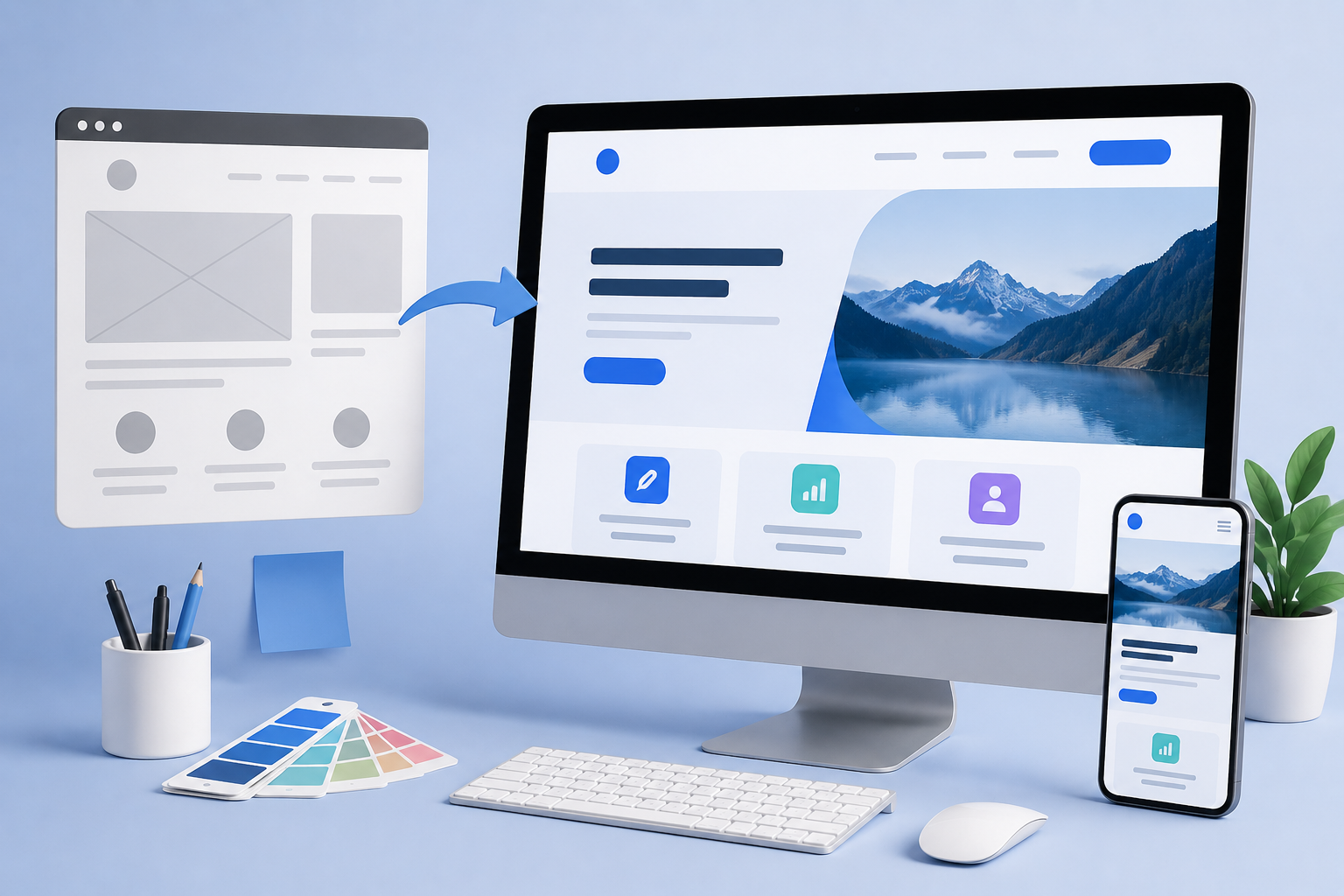
Most website problems can be fixed without a full redesign. A redesign is the most expensive solution to many problems that have cheaper fixes — but it’s also the right call in specific situations. The difference between those two situations is worth understanding before you spend five to fifteen thousand dollars.
The instinct to redesign usually comes from a specific frustration: the site isn’t generating calls, or it looks dated, or a competitor’s site looks better. Those are real problems. But the question worth asking before committing to a full rebuild is: what specifically is broken, and is a redesign the only way to fix it?
A redesign changes everything simultaneously: the design, the structure, the URLs, the content, the internal links, the schema. That comprehensiveness is its strength. It’s also how businesses routinely lose 40-60% of their organic traffic in the six months after a launch when the process is handled wrong. Technical SEO risks from a redesign done without proper migration planning are among the most common causes of ranking drops that took years of work to build.
Table of Contents
| A redesign changes everything at once. That’s its strength when the whole foundation is wrong — and its risk when only specific things need fixing. |
The Decision Framework: Redesign vs. Optimize
The choice between redesign and optimization comes down to one question: are the problems you’re experiencing fixable without rebuilding the site’s foundation? Run your current situation through this checklist.
| Your Situation | Answer | Why |
| Site looks dated but loads and converts adequately | Optimize | Visual updates can often be done with a new theme or CSS changes on the existing platform |
| Phone number not visible on mobile | Optimize | Header layout and sticky element — a developer fix, not a rebuild |
| Pages load slowly | Optimize | Image compression, hosting upgrade, and plugin reduction fix 80% of speed issues without rebuilding |
| Site not ranking for target keywords | Optimize | On-page SEO, content, and schema are typically the gap — not the design |
| Site doesn’t generate calls despite traffic | Optimize | Trust gaps and conversion signals — fixable with targeted content and layout changes |
| Missing service pages or city pages | Optimize | Content additions don’t require a rebuild |
| Built on a platform that can’t do what you need | Redesign | Platform limitations require migration — no optimization path exists |
| URL structure is a mess with no logical hierarchy | Redesign | Structural architecture overhaul is a rebuild by definition |
| Site is not mobile-responsive on any device | Redesign | Retrofitting responsiveness onto old fixed-width sites is usually more work than rebuilding |
| Brand has fundamentally changed | Redesign | New brand identity requires new visual design system — can’t be patched |
| Site was built 8+ years ago on a deprecated theme or plugin set | Redesign | Security, compatibility, and performance debt accumulate past the point of efficient optimization |
| You need functionality the current platform blocks (booking, memberships, etc.) | Redesign | Platform-level constraints require migration |
The common thread in the ‘Optimize’ column: these problems are addressable with targeted interventions. The common thread in the ‘Redesign’ column: the underlying foundation is wrong and patching it costs more than replacing it.
What Optimization Can Fix Without a Redesign
These are the most common website problems that local service businesses try to solve with a redesign but don’t need to.
Trust gaps and conversion signals
The most common reason a local service website doesn’t generate calls is a trust gap, not a design problem. Missing photos of real people, generic service descriptions, no reviews displayed, pricing questions ignored. These are content and credibility changes that can be made to an existing site in a few hours. A new design with the same content gaps produces the same conversion rate.
Page speed
Most local service WordPress sites have three to five speed problems that account for the majority of their load time. Uncompressed hero images. Hosting with slow server response times. A plugin stack loading unnecessary scripts. Addressing these three things typically produces an LCP improvement of 1-3 seconds without touching the design.
On-page SEO and content
Adding service pages, improving title tags, adding FAQ schema, fixing H1 mismatches, creating city pages — none of this requires a redesign. These are content and configuration changes that can be made to any functioning WordPress site. Many businesses rebuild their sites believing the content problems are design problems, then discover the new site has the same thin content as the old one.
Internal link architecture
Connecting orphaned pages, adding hub-to-spoke links, linking blog posts to service pages: all of this happens in the WordPress editor. A deliberate internal linking pass on an existing site often produces more ranking movement than a redesign would have, because the redesign would have reset the clock on existing page authority.
| A new design with the same content gaps produces the same conversion rate. Redesigns fix design problems. They don’t fix content, credibility, or SEO problems. |
The SEO Risks of a Redesign Done Wrong
This is the section most web design agencies won’t show you. A poorly executed redesign is one of the most reliable ways to lose rankings that took years to build. The risks are specific and preventable, but they require deliberate planning that many redesign projects skip.
| The Most Common Redesign SEO Mistakes 1. Changing URL structure without 301 redirects from every old URL to the new equivalent 2. Removing or significantly reducing content on pages that were ranking 3. Switching platforms without migrating schema markup 4. Rebuilding the internal link architecture and breaking existing authority flow 5. Launching the new site while the ‘noindex all’ developer setting is still active 6. Not preserving canonical tags during migration 7. Consolidating multiple pages into one without redirecting the removed URLs |
URL changes without redirects
This is the single highest-risk element of any redesign. If your old site had a URL at /services/hvac-repair/ and the new site puts the same content at /hvac-repair/, any rankings, backlinks, and Google Business Profile links pointing to the old URL are now pointing to a 404 page. The authority accumulated over years on that URL is lost.
A complete redirect map — every old URL mapped to its new equivalent, must be built before launch and verified after. For a site with 20-30 pages, this is a few hours of work. For a site with hundreds of blog posts and service pages, it’s a project in itself.
Content reduction
Redesigns frequently reduce content in the name of visual cleanliness. Service pages that had 600 words get replaced with 150 words and a large image. A page that was ranking for specific queries because of its content depth stops ranking because the content that earned those rankings no longer exists.
Every page that was generating meaningful impressions in Google Search Console should have its content preserved and migrated to the new site. Visual redesign should not reduce content. It should present the same content more effectively.
Platform migration without schema transfer
Switching from WordPress to Squarespace, Wix, or any other platform typically means losing all structured data markup. Schema markup doesn’t migrate automatically between platforms. A site that had LocalBusiness schema, Service schema, and FAQPage schema implemented on WordPress will have none of those on a Squarespace migration unless they’re manually rebuilt.
The noindex launch problem
During development, most developers set the entire site to ‘discourage search engines’ or apply a noindex tag sitewide to prevent a half-built site from appearing in search results. This is correct practice during development. Forgetting to remove it before launch means the new site is telling Google to ignore it entirely, while the old site has been taken down.
Verify the noindex setting is removed before launch. Then verify again in Google Search Console after launch. This specific mistake has caused businesses to lose months of rankings because nobody checked.
The SEO-Safe Redesign Checklist
If you’ve decided a redesign is the right call, these steps protect your rankings during the transition:
- Crawl the old site before touching anything. Use Screaming Frog or a similar tool to capture every URL currently on the site. This becomes the basis for your redirect map.
- Export your Search Console data. Download your current queries, impressions, and clicks data. After launch, this is your baseline for measuring whether traffic held, dropped, or improved.
- Build a complete redirect map. Every old URL that will change maps to its new equivalent. No old URL should 404 after launch.
- Preserve or improve all ranking page content. Any page with meaningful impressions in Search Console keeps its content. Visual redesign, yes. Content removal, no.
- Migrate all schema markup. LocalBusiness, Service, FAQPage, and any other structured data gets rebuilt on the new platform before launch.
- Verify noindex is off before launch. Check it in the WordPress settings and check it in the page source. Then check it again after launch with Google’s URL Inspection tool.
- Submit the new sitemap to Search Console immediately after launch. This signals Google to crawl the new structure rather than waiting for passive discovery.
- Monitor Search Console daily for the first 30 days. Coverage errors, 404s, and crawl anomalies appear quickly. Catching and fixing them early prevents prolonged ranking drops.
| Timeline Expectations After a Clean Redesign Weeks 1-2: Google recrawls the site and processes redirects. Expect minor fluctuations. Weeks 3-6: Rankings may dip 10-20% as Google re-evaluates the new site structure. This is normal. Months 2-3: Rankings typically stabilize at or above pre-launch levels if the migration was clean. Months 4-6: If content, schema, and internal linking improved in the redesign, you may see ranking improvements beyond the pre-launch baseline. If rankings have not recovered by month 3, audit for missed redirects, content removal, or schema loss. |
The Honest Recommendation
If your current site is on a reasonably modern WordPress installation with a maintained theme, is mobile-responsive, and loads in under 5 seconds: the most likely path to more calls and better rankings is optimization, not a rebuild. Fix the trust gaps. Add the content. Implement the schema. Those changes can happen in weeks, not months, and they don’t carry the ranking risk a full redesign does.
If your site is on a deprecated platform, has a broken URL structure, is not mobile-responsive, or has accumulated years of technical debt that makes every optimization a workaround. A redesign done properly is the right investment. The key phrase is ‘done properly,’ with a redirect map, content migration, schema migration, and a 30-day post-launch monitoring plan.
If you’re not sure which applies to your site, a website and SEO audit that looks at both the technical state of the current site and the specific problems you’re experiencing will tell you which path produces the better return on your investment.
| Not sure whether your site needs a redesign or targeted optimization? 1-FIND offers a free website audit for local businesses in the Tri-Cities. We’ll tell you honestly whether your problems require a rebuild or whether targeted optimization gets you where you need to go faster and for less. |