Ranking position doesn’t determine whether you appear in a Google AI Overview. Structure does. That distinction changes how you optimize.
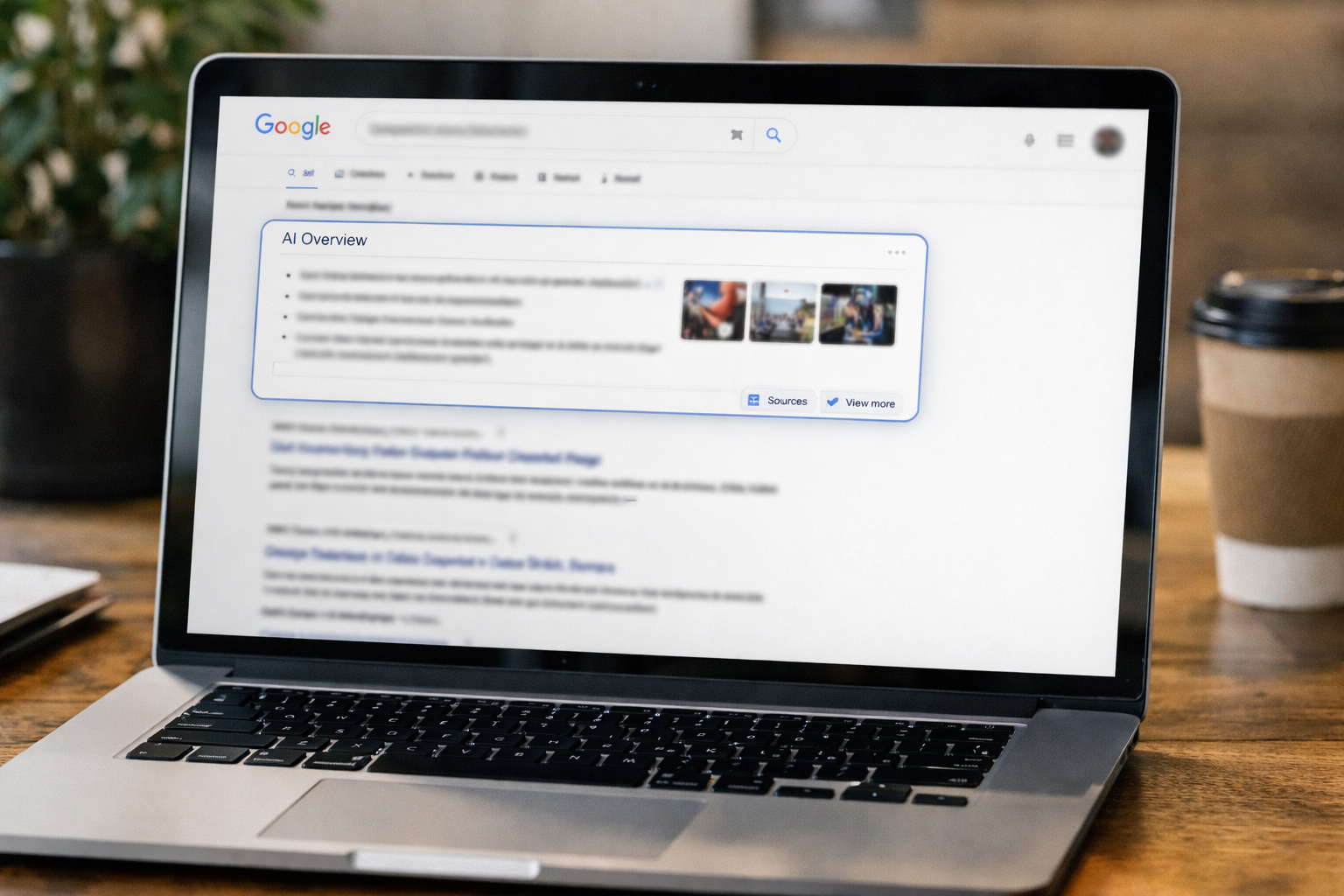
Google AI Overviews are the AI-generated summaries that appear at the top of search results for a growing range of queries. They’ve been live in the US since mid-2024, they’ve expanded to more query types, and for local service businesses researching how to be found, they represent both an opportunity and a misunderstood ranking factor.
The misunderstanding is common: many businesses assume that appearing in AI Overviews requires ranking in the top three organic results. The actual mechanism is different. Google selects sources for AI Overviews based on how extractable the answer is, not just how authoritative the page is. A well-structured page ranking at position seven can appear in an AI Overview while a thin page ranking at position two gets passed over.
This post covers how AI Overviews actually work, what makes a page extractable versus invisible to the AI summary system, which query types trigger them, and what local service businesses should specifically do to improve their chances of being cited. If you’re new to the broader topic, the AEO overview post covers the full landscape of AI search surfaces. This post goes deep on Google’s implementation specifically.
Table of Contents
| A page ranking at position 7 with a well-structured direct answer can appear in an AI Overview while a thin page at position 2 gets skipped. Structure matters more than position. |
What AI Overviews Are and How They Differ From Featured Snippets
AI Overviews are often confused with featured snippets, the single-source answer boxes that have existed in Google search for years. They’re related but meaningfully different.
A featured snippet pulls a direct excerpt from one specific page and displays it verbatim above the organic results. The source is clearly attributed and the content is unmodified. Getting a featured snippet means Google found your page’s exact phrasing to be the best direct answer to a specific query.
An AI Overview is a synthesized response generated by Google’s AI, drawn from multiple sources simultaneously. It doesn’t quote any single source verbatim: it synthesizes information across pages and presents it as a unified answer, with citations linking to the contributing sources. The pages cited may be ranked anywhere from position 1 to position 15 or beyond in the organic results, because Google’s selection criterion is not ranking position but answer quality and extractability.
The practical implication is significant: featured snippet optimization is about having the best single passage. AI Overview optimization is about having well-structured, consistently accurate, extractable content that contributes a useful piece of an answer, even if your page doesn’t rank first.
| AI Overview vs. Featured Snippet Featured Snippet: one source, verbatim text, appears for specific query phrasing, replaces the first organic result AI Overview: multiple sources, synthesized content, appears for broader query types, appears above all organic results Featured Snippet optimization: craft the best single answer passage AI Overview optimization: structure content so the AI can extract and attribute your contribution accurately Both can coexist in the same search result for different queries. |
The Extractability Framework: Five Structural Signals
Google’s AI system needs to read your page, understand what question it answers, extract a useful piece of information, and attribute it to you accurately. Pages that make each of those steps easy get cited. Pages that require the AI to infer, guess, or synthesize without clear source material get skipped.
These are the five structural signals that make a page extractable:
1. Question-formatted headings
When a heading is phrased as a question, the AI system can immediately map the heading to a query intent and locate the answer in the paragraph that follows. A heading like ‘How much does a website redesign cost?’ followed by a direct answer is a clean extraction target. A heading like ‘Pricing Considerations’ followed by several paragraphs that eventually mention cost ranges is harder to extract and less likely to be cited.
This doesn’t mean every heading on your site needs to be a question. It means that the pages you most want cited in AI Overviews (typically your informational blog content and FAQ sections) benefit significantly from question-structured headings that directly match the queries your prospects run.
2. Direct answers in the first sentence after a heading
The AI extraction system pulls the most answer-dense content it can find. If the first sentence after a heading is a direct answer to the implied question, extraction is clean. If the first sentence is contextual setup (‘Before we get into pricing, it’s worth understanding how the industry works…’), the AI has to read further to find the answer, and other pages that lead with the answer will be preferred.
The pattern is consistent: heading that states the question, followed immediately by a direct answer of one to three sentences, followed by supporting detail. That structure serves both readers who want the quick answer and the AI system that needs a clean extraction point.
3. Consistent entity language
AI systems build an understanding of what your business is and what it does by reading how you describe yourself consistently across your website, your Google Business Profile, and third-party sources. When your business is described differently in different places (different service names, different city references, inconsistent business name formatting) the AI’s confidence in attributing content to your specific entity decreases.
Practically: use the same service terminology across all of your pages. If you call it ‘missed call text-back’ on your service page, use that same phrase in your blog content. If your GBP lists your business as ‘Casey Carmical 1-FIND Services,’ your website should reflect the same name. Consistency is a citation confidence signal.
4. FAQ schema markup
FAQ schema is structured code that explicitly marks up question-and-answer pairs in a format Google’s AI can parse without inferring structure from prose. A page with FAQ schema is telling Google directly: ‘This heading is a question, and this paragraph is the answer.’ That explicit declaration removes ambiguity and makes the page significantly more extractable than identical content without schema. The schema markup guide covers the specific implementation for service businesses.
5. Topical depth across a cluster, not a single page
AI Overviews draw from multiple pages on the same site when that site has demonstrated authority across a topic. A site with one blog post about HVAC marketing will contribute less to an AI Overview on that subject than a site with five posts covering different angles of the same topic, even if the single post is technically more comprehensive. Building a topical cluster of related content increases your probability of being cited across the query set associated with that topic, not just for the single query your best page targets.
| A well-structured page that answers one question clearly is more extractable than a comprehensive page that buries the answer in supporting context. |
Which Query Types Trigger AI Overviews
AI Overviews appear on some query types much more consistently than others. Understanding the pattern helps you prioritize which content to optimize for AI extraction versus traditional ranking.
|
Query Type |
AI Overview? |
Example |
|
Informational / how-to |
Yes |
“how to choose a local SEO company” / “what does title insurance cover” |
|
Comparison / vs. |
Yes |
“SEO vs Google Ads for small business” / “CRM vs spreadsheet” |
|
Definition / what is |
Yes |
“what is the Google Map Pack” / “what is AEO” |
|
Cost / pricing |
Yes |
“how much does SEO cost” / “HVAC replacement cost” |
|
Process / steps |
Yes |
“steps to optimize Google Business Profile” / “how to get more reviews” |
|
Transactional / near me |
Rarely |
“HVAC repair near me” / “plumber Johnson City” |
|
Branded / navigational |
No |
“1-FIND Services” / “login to GoHighLevel” |
|
Local Map Pack queries |
No |
“best dentist Johnson City” / “restaurant near me” |
The pattern for local service businesses: AI Overviews appear on the research and comparison queries that happen before someone picks up the phone. Optimizing for AI Overview inclusion means creating content around those pre-purchase questions, not around the transactional queries that drive direct calls.
The Before/After: What Makes a Page Extractable
The difference between a page that gets cited and one that gets skipped is often a matter of structure rather than substance. The same information, organized differently, produces completely different extraction outcomes.
|
Element |
Hard to Extract |
Extractable |
|
Heading |
SEO Costs and Considerations |
How Much Does Local SEO Cost for a Small Business? |
|
First sentence |
Pricing varies depending on many factors including scope, competition, and deliverables. |
Local SEO for a small business typically costs between $500 and $2,000 per month, depending on market competition and service scope. |
|
Answer structure |
Answer buried in paragraph 3 after two paragraphs of context |
Direct answer in first sentence, supporting context in sentences 2–3 |
|
Schema |
No structured data markup |
FAQ schema explicitly marking Q&A pairs |
|
Entity language |
Company described differently on each page |
Consistent service names and business description across all pages |
The content in both versions can be identical. The structure determines extractability.
What Local Service Businesses Should Prioritize
The query types that trigger AI Overviews map almost exactly to the informational content local service businesses are most underinvested in. Most local service websites are built around service pages and contact forms. The research-stage content that answers pre-purchase questions is largely absent.
That gap is an opportunity. A local HVAC company that publishes a well-structured post on ‘how to choose an HVAC company in the Tri-Cities’ has very few competitors for that specific query in that specific market, and the content type is exactly what triggers AI Overview inclusion. The same applies for ‘what questions to ask a title company,’ ‘how to know if you need a CPA,’ or ‘how much does a website redesign cost in Johnson City.’
The practical priority list for a local service business:
- Audit your existing informational content for extractability. Run your current blog posts against the five structural signals above. Posts that answer a question but don’t lead with the answer, or that have no FAQ schema, are candidates for a quick structural edit that could produce AI Overview inclusion without new content.
- Identify the 3–5 research questions your prospects ask before calling. These are the pre-purchase queries where AI Overviews appear. They’re usually ‘how to choose,’ ‘how much does it cost,’ ‘what should I look for,’ and ‘what’s the difference between X and Y’ questions in your service category. Each one is a content target.
- Structure new informational content for extraction from the start. Question headings, direct answers in the first sentence, FAQ schema. Build this into your content template so every new informational post is extraction-ready.
- Check entity consistency across your site and GBP. Inconsistent business name, service names, or location descriptions reduce attribution confidence. A quick audit of your most important pages against your GBP listing will surface any gaps.
- Track which queries trigger AI Overviews in your category. Search the pre-purchase questions your prospects ask and observe which ones produce AI Overviews. Those are your highest-value content targets for this specific optimization.
How to Check Whether You’re Being Cited
Google Search Console doesn’t currently provide a dedicated AI Overview performance report, but there are practical ways to check your current citation status and monitor for changes.
- Manual search monitoring. Search the informational queries most relevant to your business and observe whether AI Overviews appear and which sources they cite. This takes time but gives direct visibility into what Google is citing for your most important query categories.
- URL inspection in Search Console. When you publish or restructure a page for AI Overview optimization, use Google Search Console’s URL inspection tool to request indexing. This speeds up the window between publishing and Google’s first read of the updated structure.
- Tracking citations in third-party tools. Some SEO tools have begun tracking AI Overview citations alongside traditional rankings. The data is still developing, but tools in the BrightLocal and SE Ranking ecosystem have started adding AI Overview visibility tracking.
- Monitoring branded queries. Search your business name alongside your primary service categories to see whether your content appears in AI Overviews for branded-adjacent queries. These searches are the most reliable indicator of whether Google has established sufficient entity confidence to cite you.
| The businesses that will appear in AI Overviews consistently in 2027 are the ones building extractable, structured informational content today. The window of low competition is still open. |
| Want help building content that appears in Google AI Overviews? 1-FIND’s SEO and AEO services for Johnson City businesses include content structuring, FAQ schema implementation, and entity consistency audits specifically designed to improve AI Overview citation rates alongside traditional local search rankings. |