
If you’ve ever heard an agency throw around terms like “on-page SEO,” “technical SEO,” or “AEO” without explaining what any of them actually mean, you’re not alone. SEO is broad, and the vocabulary around it can make it feel more complicated than it needs to be.
Table of Contents
This guide to SEO breaks down each major type of SEO in plain language—what it is, why it matters, and what it looks like in practice. Whether you’re evaluating a marketing investment or trying to understand what your current agency is doing, this is your reference.
On-Page SEO: What Lives on Your Website
On-page SEO covers everything you can control directly on your website—the words, structure, and signals that tell search engines what each page is about and why it should rank for relevant queries.
The foundation is keyword research: understanding what terms your potential customers are actually searching for, and making sure those terms appear naturally in your page titles, headings, body content, and meta descriptions. But on-page SEO has evolved well beyond keyword placement. Search engines now evaluate whether your content genuinely answers what the searcher is looking for—not just whether the right words appear on the page.
Practical on-page work includes:
- Writing clear, descriptive title tags and meta descriptions for every page
- Using heading tags (H1, H2, H3) to organize content so both readers and search engines can follow the structure
- Creating service and product pages that thoroughly address what customers need to know
- Adding internal links that connect related content across your site
- Allowing and responding to customer reviews, which contribute fresh, keyword-rich content
On-page SEO is usually the highest-leverage starting point because it directly shapes how your site communicates its relevance to search engines.
Off-Page SEO: Your Reputation Beyond Your Website
Off-page SEO refers to everything that builds your website’s authority and credibility from the outside. While you control what’s on your own site, off-page signals come from other sources—and that’s partly what makes them so valuable to search engines.
The cornerstone of off-page SEO is backlinks: links to your site from other reputable websites. A link from a trusted local news outlet, an industry association, or a well-regarded partner business signals to Google that your site is worth sending people to. Not all backlinks are equal—one high-quality, relevant link is worth more than dozens from low-authority or unrelated sites.
Off-page SEO also encompasses:
- Social media presence and engagement, which drives brand awareness and traffic even without a direct ranking signal
- Influencer and community mentions that generate shares and inbound interest
- Online reputation management—monitoring and responding to reviews across platforms like Google, Yelp, and industry-specific directories
- Guest content and collaborations that place your expertise on other authoritative platforms
For local businesses, off-page SEO and local SEO overlap significantly. Getting cited in local publications, earning reviews, and being listed in relevant directories all contribute to your off-page authority.
Technical SEO: The Infrastructure Underneath
Technical SEO is about making sure search engines can actually access, read, and understand your website—and that visitors have a fast, smooth experience when they get there. Think of it as the foundation your content sits on. Even the best-written, most relevant pages struggle to rank if the underlying site has technical problems.
The three main areas technical SEO addresses are speed, structure, and accessibility.
Speed
Google uses page loading speed as a direct ranking factor. Slow sites frustrate users and get penalized in search results. Technical optimizations like compressing images, minimizing unnecessary code, and leveraging browser caching can significantly improve load times—often without touching any visible content.
Structure and Crawlability
Search engine bots “crawl” your site to discover and index your pages. Technical SEO ensures that crawl is efficient: a clean URL structure, a properly configured XML sitemap, robots.txt files that guide bots to the right places, and internal linking that connects your content logically all help search engines understand what you have and how it’s organized.
Mobile Responsiveness
Google indexes the mobile version of your site first—a practice called mobile-first indexing. If your website doesn’t display cleanly on smartphones, you’re not just giving mobile users a bad experience; you’re actively hurting your rankings. Technical SEO ensures your site adapts correctly to all screen sizes.
Other technical areas include HTTPS security, fixing broken links, eliminating duplicate content, and implementing structured data (schema markup) that helps search engines interpret your pages more precisely.
Local SEO: Reaching Customers in Your Area
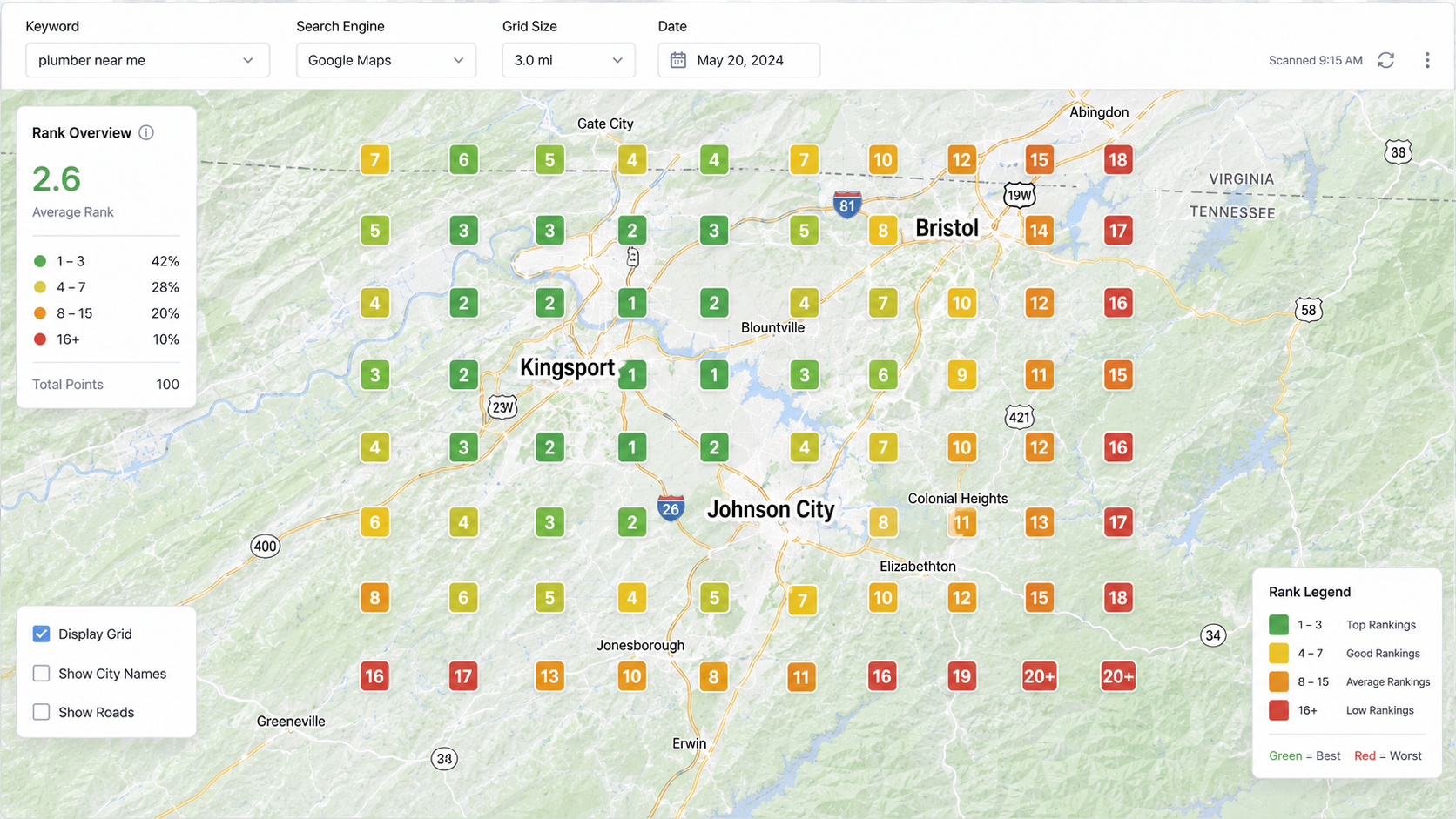
Local SEO is the practice of optimizing your online presence so that nearby customers find you when they search for what you offer. For businesses with a physical location or a defined service area—which describes most businesses in Johnson City and the Tri-Cities—local SEO is where the most direct return on investment lives.
At its core, local SEO is built on three pillars: proximity (how close you are to the searcher), relevance (how well your content matches what they’re looking for), and prominence (how trusted and well-known your business appears online).
The practical elements of local SEO include:
- Claiming and fully optimizing your Google Business Profile with accurate information, photos, and regular posts
- Building consistent citations—your business name, address, and phone number—across directories like Yelp, Bing Places, and Apple Maps
- Earning and managing Google reviews from real customers
- Using location-specific keywords throughout your website content
- Creating service-area pages that target the specific cities and neighborhoods you serve
Local SEO is what determines whether your business shows up in the map pack—the three listings that appear at the top of local search results. For service-based businesses, healthcare practices, and retailers competing in a defined geographic market, it’s the highest-priority SEO investment. We cover local SEO in depth in our complete guide to Local SEO for Tri-Cities businesses.
Content SEO: Building Authority Through What You Publish
Content SEO is the practice of creating and organizing website content specifically to rank in search results and establish your business as a credible resource in your field. It’s closely related to on-page SEO but focuses more on the strategic planning and ongoing production of content rather than the optimization of individual pages.
The goal is to match your content to the questions, concerns, and searches of your target customers at every stage of their decision-making process. Someone searching “how often should I get a dental cleaning” is in a different mindset than someone searching “dentist accepting new patients in Kingsport”—and good content SEO addresses both.
A solid content SEO approach typically includes:
- A blog or resource section with regularly updated articles targeting informational keywords
- Service pages that go beyond a brief description and thoroughly address what customers need to know before making a decision
- Pillar pages that serve as comprehensive guides on major topics, supported by more specific sub-articles
- How-to guides, FAQs, and educational content that address common customer questions
Content SEO is also the primary mechanism for building topical authority—the process by which your site becomes recognized by Google as an expert resource on a specific subject area. Consistent, quality publishing compounds over time, making your site progressively more competitive for relevant searches.
Mobile SEO: Optimizing for Where People Actually Search
Mobile SEO specifically addresses the experience users have when visiting your site on a smartphone or tablet. While mobile optimization is technically part of both technical SEO and on-page SEO, it deserves its own attention given that the majority of local searches today happen on mobile devices.
A mobile-optimized site adjusts its layout to fit any screen size, loads quickly on cellular connections, uses tap-friendly navigation, and avoids elements like intrusive pop-ups that interrupt the mobile experience. Google penalizes sites that fail these tests—and more importantly, so do users, who will simply leave a site that’s frustrating to use on their phone.
For local businesses, the mobile experience is especially critical because many mobile searchers are looking for immediate, location-based information: your phone number, your hours, your address, directions. If those aren’t easy to find on mobile, you’re losing customers at the moment they’re ready to act.
Voice Search SEO: Optimizing for How People Actually Talk
Voice search is now a significant share of local queries, driven by the use of virtual assistants like Siri, Google Assistant, and Alexa. Voice queries are structurally different from typed searches—they tend to be longer, more conversational, and often phrased as direct questions.
Someone typing might search “dentist Johnson City TN.” The same person using voice might ask “Who is a good dentist near me accepting new patients?” Optimizing for voice search means creating content that naturally addresses the way people speak, not just the shorthand keywords they type.
Practical voice search optimization includes:
- Adding an FAQ section to your website that addresses common questions in natural language
- Writing content that directly answers question-based searches (who, what, where, when, why, how)
- Keeping your Google Business Profile accurate, since voice assistants often pull business information directly from it
- Targeting featured snippet positions in Google, which voice assistants frequently read aloud as answers
Voice search and Answer Engine Optimization (AEO) overlap significantly—see our companion piece on SEO and AEO for a deeper look at how AI-driven search is changing the picture.
UX SEO: When User Experience and Search Rankings Converge
User experience SEO (sometimes called UX SEO) reflects a fundamental shift in how Google evaluates websites. It’s no longer enough for a page to contain the right keywords—Google now measures whether users actually have a good experience when they visit. Signals like how long people stay on your site, how quickly they navigate away, and how often they click through from search results all feed into how Google ranks your pages.
Core UX factors that affect SEO include:
- Page load speed—slow pages see higher bounce rates, which signals a poor experience
- Clear, logical navigation that helps visitors find what they came for quickly
- Readable design with appropriate contrast, font sizes, and spacing
- Minimal friction—no intrusive pop-ups, confusing layouts, or dead ends
- Content that actually delivers on the promise of the page title and meta description
UX SEO and technical SEO overlap considerably. The difference is in emphasis: technical SEO focuses on what search engines can read, while UX SEO focuses on what human visitors actually experience. In practice, improving one typically improves the other.
How These Types Work Together
SEO is not a menu where you pick one item—it’s a system where each type reinforces the others. Technical SEO ensures search engines can crawl and index your content. On-page and content SEO give them something worth indexing. Off-page and local SEO build the authority that convinces Google your site deserves to rank. Mobile and voice SEO ensure you’re capturing traffic across every device and search behavior. UX SEO ensures that the visitors you attract stay, engage, and convert.
For most local businesses, the practical priority order is: local SEO and Google Business Profile first, then on-page and technical fundamentals, then ongoing content and off-page work. The right sequence depends on where your biggest gaps are—which is exactly what a proper SEO audit identifies.
Work with 1-FIND on Your SEO Strategy
At 1-FIND, we’re a Johnson City-based digital marketing agency offering local SEO services in Johnson City built around what actually moves the needle for local businesses—not generic checklists. We handle everything from technical audits and Google Business Profile management to content creation and citation building.
If you’re not sure where your site stands or where to start, a Local SEO audit is the best first step. We’ll show you exactly what’s working, what isn’t, and what the highest-leverage opportunities are for your specific business and market.
Contact us today to get started.