
The conversation around AI and search has gotten loud, and a lot of it is genuinely alarming if you take it at face value. Google’s AI Overviews are answering questions directly in search results. ChatGPT and Perplexity are routing millions of queries away from traditional search engines entirely. Voice assistants are delivering single answers instead of lists of links.
For businesses that built their marketing around organic search traffic, this sounds like an existential threat. And for some types of businesses, in some categories, it is a real challenge worth taking seriously.
But for local service businesses, the dentists, HVAC companies, med spas, contractors, law firms, and healthcare providers that make up the majority of small business search traffic, the disruption is far more limited than the headlines suggest. The reason comes down to a distinction that most of the AI-is-killing-SEO coverage glosses over: the difference between informational searches and commercial intent searches.
Table of Contents
The Two Types of Search, and Why Only One Is Being Disrupted
Not all searches are equal, and AI handles them very differently.
Informational searches are questions where the searcher wants an answer. “How does a dental implant work.” “What are the signs of a gas leak.” “How long does an HVAC system last.” These queries have always driven significant traffic to blogs and informational websites, and AI is genuinely good at answering them. Google’s AI Overviews, ChatGPT, and similar tools can synthesize a clear, accurate response without the user needing to click through to a website at all.
Traffic to purely informational content has declined on many sites as a result. If your content strategy was built primarily around answering general knowledge questions, that decline is real and it is going to continue.
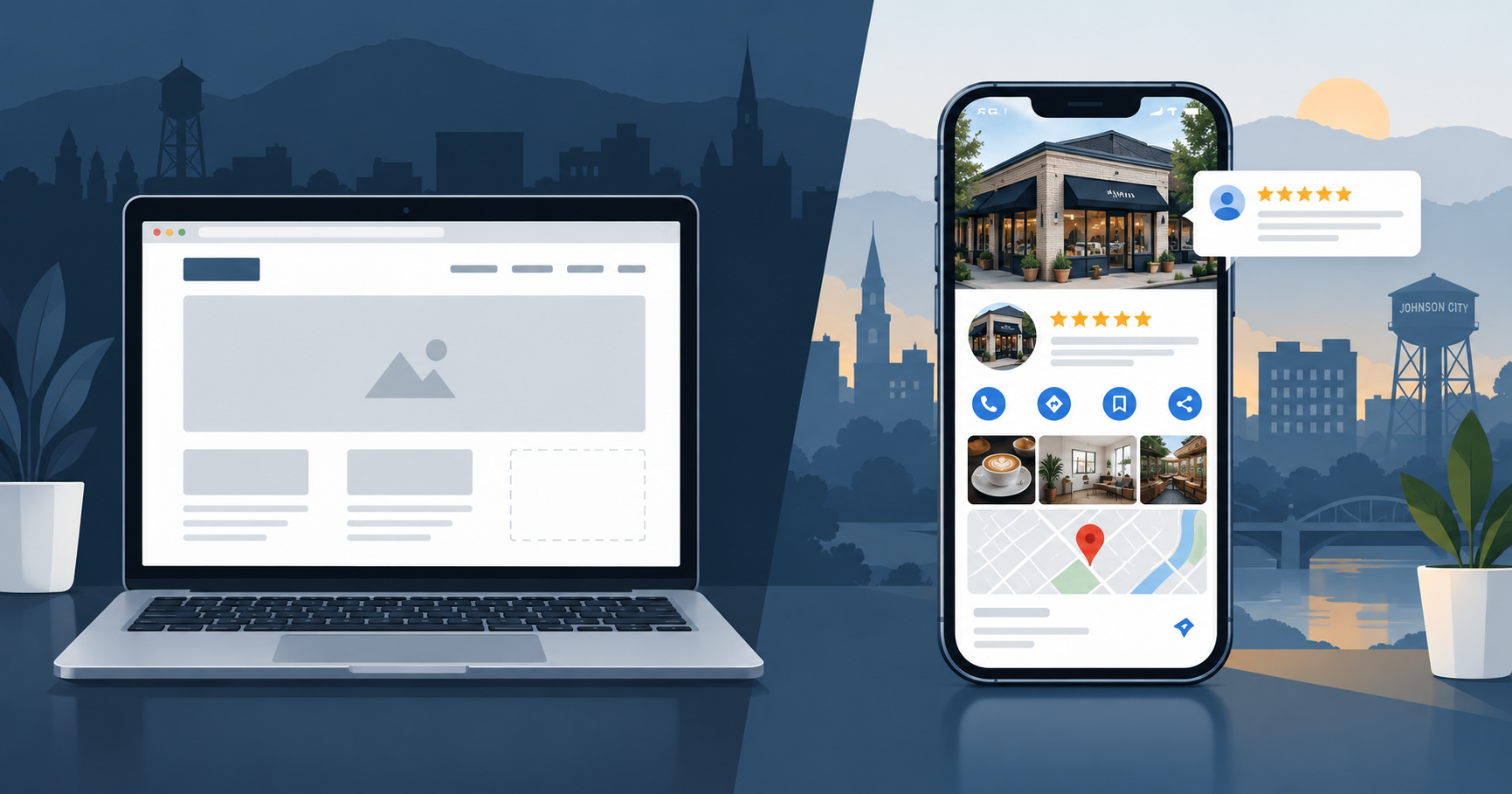
Commercial intent searches are a fundamentally different animal. When someone searches “emergency plumber Johnson City,” “dentist accepting new patients near me,” or “IV therapy Kingsport,” they are not looking for information. They need a specific business, in a specific location, to perform a specific service. They need a phone number to call, a location to visit, or an appointment to book.
AI cannot fulfill that need. It can tell you how plumbing works. It cannot send a licensed plumber to your house at 9pm on a Sunday. It can explain what a dental implant procedure involves. It cannot book you an appointment with a practice two miles from your office that has availability next Tuesday.
For those searches, Google still returns the Map Pack and local organic results — because that’s the only response that actually satisfies the searcher’s intent. And that is not changing.
What the Actual Traffic Data Shows
The narrative that “AI is killing search traffic” is real in aggregate but misleading when broken down by search type. Several patterns have emerged clearly enough to be worth stating with confidence.
Informational and educational content has taken the most significant traffic hit from AI Overviews. Sites that built traffic on broad “how to” and “what is” queries have seen meaningful declines in click-through rates as Google answers those questions directly in the results page.
Local and transactional searches have shown far more resilience. Studies tracking click behavior on local searches consistently show that Map Pack results, business profile listings, and local organic results maintain strong click-through rates — because users need to take action, not just read an answer.
There’s a structural reason for this that’s worth understanding: Google’s business model is built on connecting searchers with businesses. When someone searches for a local service, the entire value of the search engine is in delivering a business that can fulfill the need. An AI summary that says “there are several good dentists in Johnson City, you may want to check reviews and availability” is useless to the searcher. Google knows this. The local search experience has been evolving to surface better local results faster, not to replace them with AI text.
This is also why Google has been investing heavily in its Business Profile platform, Google Maps, and local search features rather than winding them down. The local search product is where Google makes a significant portion of its local advertising revenue, and it remains deeply valuable to searchers. AI Overviews are not deployed as replacements for local commercial search results.
The Searches That Do Feed Your Business and Whether AI Touches Them
To make this concrete, here’s how different search types typically break down for a local service business and where AI disruption actually lands.
Searches AI is actively displacing:
“What causes tooth sensitivity” — answered by AI Overview, fewer clicks to dental websites. “How often should I get an HVAC tune-up” — AI answers directly, informational blog traffic declines. “What is the difference between Invisalign and braces” — synthesized answer, reduced need to click through.
Searches AI is not displacing:
“Dentist Johnson City TN accepting new patients” returns Map Pack and local listings. Requires a click to act. “Emergency HVAC repair near me” returns local businesses. AI cannot dispatch a technician. “Med spa Botox Kingsport” returns local service providers. Requires booking. “Personal injury attorney Johnson City free consultation” returns local firms. Requires contact.
If you look honestly at the searches that actually bring patients, clients, or customers through your door, the overwhelming majority fall into the second category. They have commercial intent, they require local fulfillment, and they are structurally resistant to AI displacement.
What AI Search Does Change for Local Businesses
Acknowledging that local commercial searches are resilient doesn’t mean AI is irrelevant to your digital strategy. There are two areas where it does create meaningful change.
Your informational content matters less as standalone traffic, but more as authority signal.
If you’ve been publishing educational content, blog posts about dental health, HVAC maintenance guides, legal explainers, that content may be generating less direct traffic than it used to. That’s the real part of the AI traffic story.
But that content still performs an important function: it signals to Google that your business is a credible, authoritative source in your field. A dental practice with well-written, accurate content about oral health is treated as more authoritative than one with only service pages. That authority flows into your Google Business Profile ranking and your local organic visibility. The content isn’t dead; its role has shifted from direct traffic driver to authority builder.
AI systems are starting to be used for local business discovery, and your presence needs to be legible to them.
A growing number of people are beginning searches with ChatGPT, Perplexity, or Google’s AI Mode rather than traditional search. When those tools are asked “find me a good orthodontist in Johnson City,” they pull from whatever sources they’ve indexed and find credible, which includes Google Business Profiles, your website, directory listings, and review platforms.
This is where Answer Engine Optimization (AEO) becomes relevant for local businesses. Being discoverable and credible to AI systems requires the same things that traditional local SEO has always required: a complete and accurate Google Business Profile, consistent business information across directories, genuine reviews, and well-structured website content. The difference is that structured data markup, particularly LocalBusiness schema on your website, becomes more important as AI systems try to parse your business information programmatically rather than inferring it from page content.
The practical implication is not that you need a new strategy. It’s that your existing local SEO foundation needs to be solid enough to be legible to systems that are increasingly reading your digital presence rather than ranking it.
| Traditional SEO | AEO | |
| Goal | Rank higher in search results | Be selected as a trusted AI answer |
| Content style | Comprehensive, keyword-optimized | Direct, conversational, structured |
| Key signals | Backlinks, on-page elements, speed | Authority, schema markup, credibility |
| Best for | Driving traffic to your website | Appearing in AI-generated answers |
What This Means for Your Investment in SEO Right Now
The businesses most at risk from AI search disruption are those whose SEO strategy was built primarily around informational content, passive topic coverage, or broad non-local keyword targets. If that describes your current approach, it’s worth reassessing the content strategy.
The businesses least at risk are those with strong local SEO foundations: consistent citations, active Google Business Profiles, genuine review velocity, location-specific service pages, and the kind of clear business information that both human visitors and AI systems can immediately parse.
For a local service business in the Tri-Cities, the highest-value SEO investments right now are the same ones they’ve always been, and they’re more durable than ever:
Dominating the Map Pack for your core service searches. Review generation as an ongoing operational process, not a periodic campaign. A website that loads fast, clearly communicates what you do and where you do it, and gives visitors an immediate path to contact you. Content that demonstrates genuine expertise in your field rather than simply targeting keywords.
AI is changing the search landscape. For publishers, affiliate sites, and businesses relying on informational traffic, those changes are significant and ongoing. For local service businesses competing for patients, clients, and customers within a defined geographic area, the fundamentals that drive visibility haven’t been displaced. If anything, the businesses that have invested in a strong local presence are finding that the competitive moat has gotten wider, not narrower, as lower-quality content gets commoditized and the signals of genuine local authority matter more.
If you’re unsure whether your current SEO approach is built for the local search landscape as it exists now, we offer free audits for SEO services in Johnson City, Kingsport, Bristol, and across the Tri-Cities. We’ll show you where you stand, what’s actually driving your visibility, and where the real opportunities are. Request a free analysis here.