Most businesses optimize to get into the Map Pack. The better question is what happens to your click rate once you’re there — and that answer surprises most people.
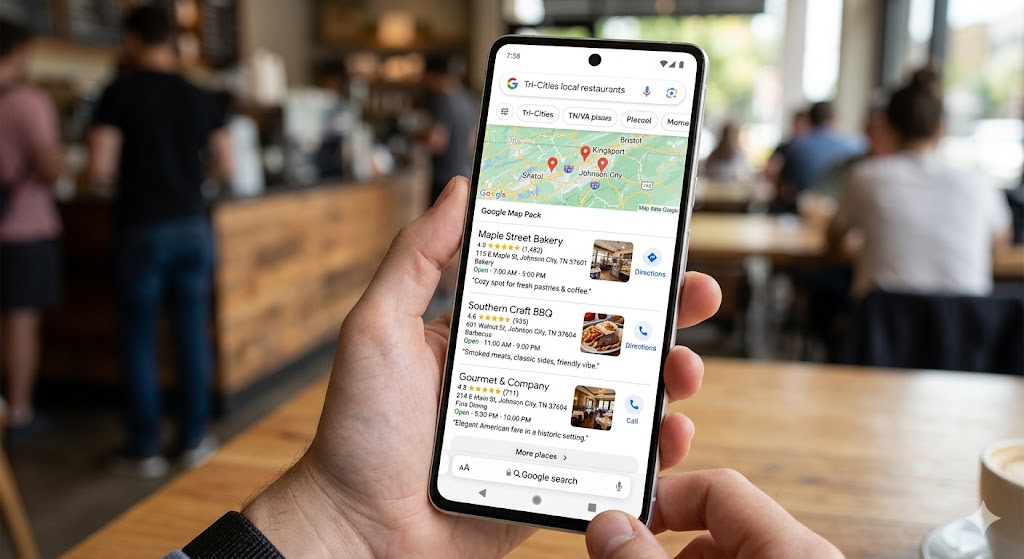
Search for almost any local service on Google and you’ll see it: a block of three business listings sitting above the organic results, each showing a name, a star rating, a review count, a phone number, and a small map. That block is the Google Map Pack, also called the local 3-pack, and it is the highest-visibility real estate in local search.
Getting into it matters. But the way most businesses think about Map Pack rankings misses something important about how prospects actually use it, and that gap is where a lot of well-ranked businesses are losing clicks to competitors below them.
Table of Contents
| Getting into the Map Pack is a ranking problem. Getting clicks once you’re there is a trust problem. Most businesses only solve the first one. |
What the Map Pack Actually Is
The Map Pack appears at the top of Google search results when Google determines a query has local intent. That determination happens automatically: someone in Johnson City searching ‘HVAC repair’ doesn’t need to type ‘near me’ for Google to show local results. Google infers the intent from the query type, the searcher’s location, and behavioral signals from millions of similar searches.
The three businesses shown are pulled from Google’s local index, which is built primarily from Google Business Profile data. The map to the right pins each business’s location relative to the searcher. On mobile, which accounts for the majority of local service searches, the Map Pack often fills the entire screen before any organic results appear.
Below the three results is a ‘More places’ link that opens the full Google Maps results, sometimes called the Local Finder. But most searchers never get there. The three visible results capture the overwhelming majority of local clicks, which is why Map Pack visibility matters as much as it does.
| Where Map Pack Traffic Actually Goes Searches with local intent on mobile: the Map Pack fills the first screen before organic results. Searchers typically compare all three results simultaneously before clicking, not sequentially. Direct calls, direction requests, and website clicks all happen from the Map Pack panel without the searcher ever visiting the business’s website. For many local service businesses, Map Pack interactions generate more inbound leads than organic website traffic. |
Why Your Ranking Isn’t a Fixed Number
The first thing most businesses misunderstand about Map Pack rankings is that position 1, 2, or 3 isn’t a stable number assigned to your business. It’s a moving target that shifts based on who’s searching and where they’re standing.
Google’s local algorithm weights proximity heavily. A plumbing company physically located in downtown Johnson City will rank higher for a searcher standing downtown than for a searcher in Gray, even if the search term is identical. The business that ranks first for one searcher may rank third for another searcher three miles away, from the same search, at the same time.
This has a practical implication that most local SEO reporting misses: when a tool tells you that you rank number one for ‘HVAC company Johnson City,’ it’s giving you a snapshot from one location. Your actual rank varies continuously across your service area. A business with a strong overall Map Pack presence in the Tri-Cities will rank first for some searchers and third for others, based on nothing more than where each person happens to be.
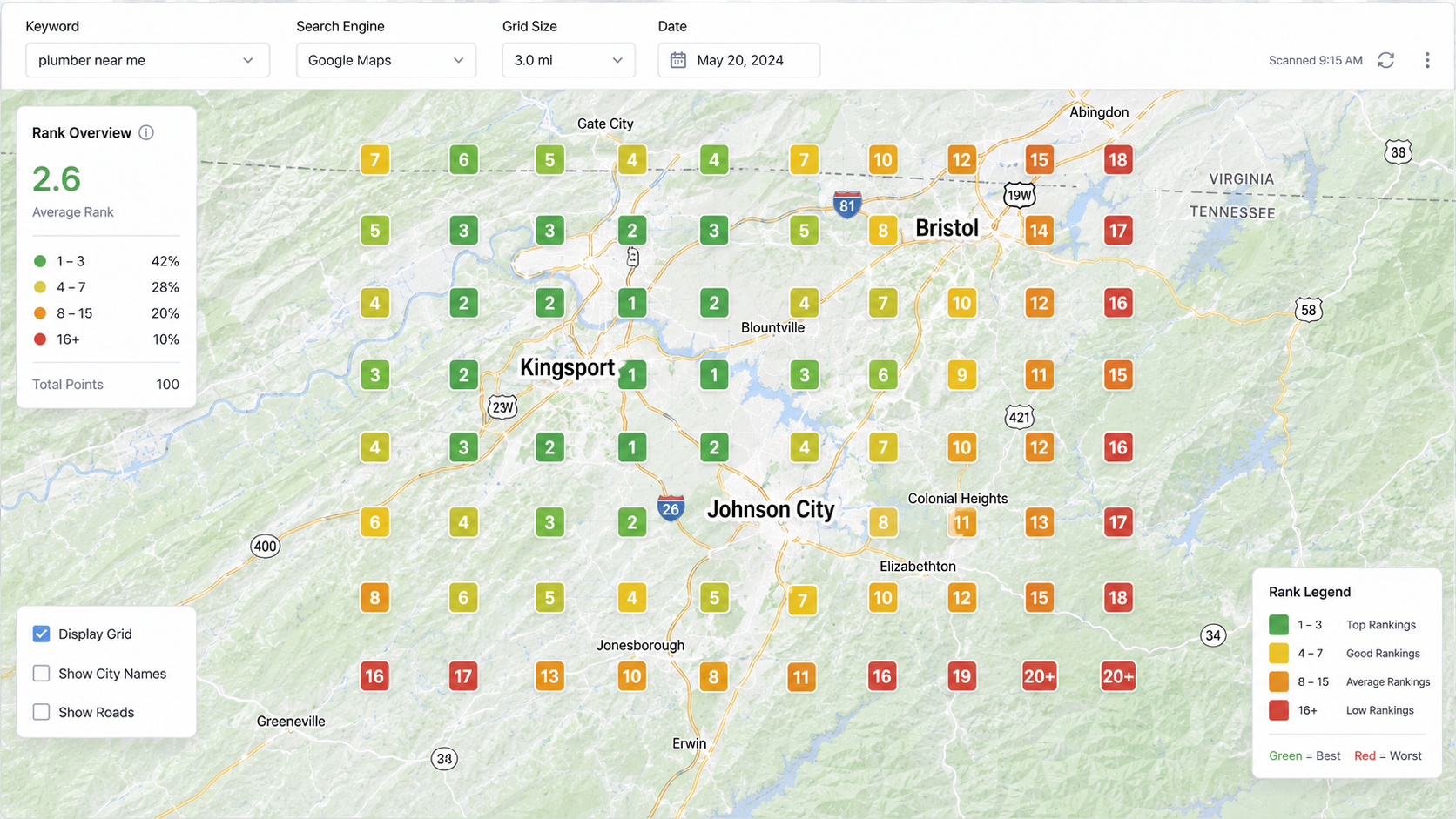
This is one reason geo-grid rank tracking, which shows your ranking position across a grid of locations in your service area, gives a more accurate picture of your visibility than a single-point ranking check. It shows you not just whether you’re in the pack, but where across your market you’re winning and where you’re falling short.
| Ranking position 1 for one searcher and position 3 for another can happen simultaneously. Local rankings are location-dependent by design. |
Why Position 3 Can Outperform Position 1
This is the part that surprises most business owners, and it’s the part that changes how you should think about Map Pack optimization once you’re in the pack.
When a prospect views the Map Pack on mobile, they don’t read sequentially from top to bottom the way they would a document. They scan all three results simultaneously, and their eyes move to the signals that matter most for their specific decision. For a local service purchase, where trust is the primary variable, those signals are review count and star rating, in that order.
A business in position 3 with 4.9 stars and 180 reviews presents a more compelling visual signal than a business in position 1 with 4.4 stars and 14 reviews. The prospect is making a trust decision, and the reviews tell that story faster than the ranking order does.
Review count matters more than most businesses expect because it implies track record. A business with 180 reviews has served 180 customers who felt strongly enough to leave feedback. A business with 14 reviews is harder to evaluate. The prospect can’t know whether the small review count reflects a new business, a business that doesn’t ask for reviews, or a business whose customers weren’t satisfied enough to say anything.
The practical outcome: two businesses in the same Map Pack, with the position-3 business having significantly more reviews, will often split clicks unevenly in favor of the lower-ranked one. Position matters, but review count at local scale is the stronger conversion signal.
| The Visual Hierarchy a Prospect Actually Uses 1. Review count — ‘How many people have used this business?’ 2. Star rating — ‘What did those people think?’ 3. Business name — ‘Have I heard of them?’ 4. Distance / location — ‘How close are they?’ 5. Hours — ‘Can I reach them right now?’ Ranking position influences which results are visible. Review signals influence which result gets the click. |
The Five Factors That Determine Map Pack Rankings
Google’s local algorithm is built around three published categories: proximity, relevance, and prominence. Those categories are real but they obscure the specific signals that actually move rankings. Based on BrightLocal’s annual Local Search Ranking Factors study, the practical ranking factors for Map Pack visibility break down like this:
|
Factor |
Weight |
What It Means in Practice |
|
GBP signals |
High |
Category selection, completeness, posting activity, photos, attribute accuracy. The most controllable factor and the most frequently misconfigured. |
|
Review signals |
High |
Quantity, recency, velocity, and response rate. New reviews signal active business; stale reviews signal stagnation. |
|
Proximity |
High |
Physical distance from the searcher. Not controllable — but service area configuration in GBP affects where you appear. |
|
On-page signals |
Moderate |
NAP consistency between your website and GBP, location pages, title tags with city names, schema markup. |
|
Citation signals |
Moderate |
Consistent business name, address, and phone across directories. Inconsistency suppresses rankings; consistency reinforces them. |
|
Behavioral signals |
Moderate |
Click-through rate, calls, direction requests, photo views from your GBP listing. Google uses engagement as a relevance signal. |
|
Link signals |
Lower |
Links to your website from local sources — chamber listings, local news, sponsor pages, industry directories. |
The practical takeaway: for most local service businesses, GBP optimization and review velocity are the two highest-return areas because they’re directly controllable and consistently underinvested in.
The Category Selection Mistake That Suppresses Rankings
The single most common and most damaging Map Pack mistake is choosing the wrong primary category in Google Business Profile. It is also the easiest to fix once you know it’s happening.
Most businesses choose the broadest category that technically applies: ‘Contractor’ instead of ‘Roofing Contractor,’ ‘Health Spa’ instead of ‘Medical Spa,’ ‘Financial Planner’ instead of ‘Certified Financial Planner.’ The reasoning is that a broader category should reach more searches. The actual outcome is the opposite.
Google’s local algorithm uses the primary category to determine which searches your listing is eligible to appear for. A broader category competes in a larger pool of businesses for a wider set of queries, most of which are not your actual business. A specific category competes in a smaller pool for a narrower set of queries that are exactly your business.
A roofing company listed as ‘Contractor’ is competing with every general contractor, plumber, and electrician in the market for that category’s query set, and winning fewer of those queries than a roofing-specific competitor. The same company listed as ‘Roofing Contractor’ ranks for roofing-specific queries against a much smaller competitive set.
The fix: check your current primary category in Google Business Profile and compare it to the most specific category that accurately describes your primary service. Google maintains a full list of available GBP categories. A dedicated GBP optimization audit will surface whether your category selection is costing you map pack visibility on your most important queries.
What Drives Clicks Once You’re in the Pack
Getting into the Map Pack is a ranking problem. Getting the click is a different problem, and the two require different work.
Once a prospect sees all three results, four things influence which one they choose:
- Review count and recency. As covered above, this is the dominant click signal. A business that consistently asks for reviews after completed jobs will accumulate count and recency advantages that compound over time. A business that relies on customers volunteering reviews on their own will fall behind businesses with any kind of systematic review request process.
- Photos. Google’s own data shows that GBP listings with photos receive more direction requests and website clicks than those without. For local service businesses, real job photos outperform stock images because they show the actual work. A prospect choosing between three HVAC companies responds to a photo of a real system installation more than a generic HVAC stock image.
- Response to reviews. A profile that responds to every review, including critical ones, signals an attentive business. Many prospects read the one- and two-star reviews specifically to see how the business responds. A professional, specific response to a complaint demonstrates character more effectively than a page of five-star reviews with no negative context.
- Hours accuracy. A prospect who needs service today will check whether you’re open before they call. Incorrect hours mean lost calls from searchers who check before dialing. Holiday hours especially should be kept current.
| Review count gets the click. Photos get the call. Hours accuracy gets the connection. Each one is a separate conversion point that most businesses leave unmanaged. |
How to Check Your Map Pack Visibility Across Your Service Area
The most common error in Map Pack tracking is checking your ranking from one location — usually your office or home — and assuming that’s representative of your visibility across your entire market. As described earlier, your ranking varies by searcher location.
A more accurate picture requires checking your ranking from multiple points across your service area. For a Johnson City or Tri-Cities business, that means checking from downtown Johnson City, from Gray, from Kingsport, from Bristol, and from other communities in your service radius. The pattern of where you rank strongly and where you fall out of the pack tells you where your GBP signals are strongest and where gaps exist.
Tools that run geo-grid ranking checks automate this by showing your ranking position on a map grid across dozens of points simultaneously. If you’re working with a local SEO partner, this kind of geo-grid data should be part of your regular reporting. A one-time snapshot tells you where you stand today; a recurring view tells you whether your work is moving the needle.
| Want to know where you stand in the Map Pack across the Tri-Cities? 1-FIND runs geo-grid Map Pack audits for Johnson City SEO and Google Maps optimization. We’ll show you where you’re winning, where you’re falling out of the pack, and exactly what’s suppressing your visibility — with a prioritized action list to close the gaps. |