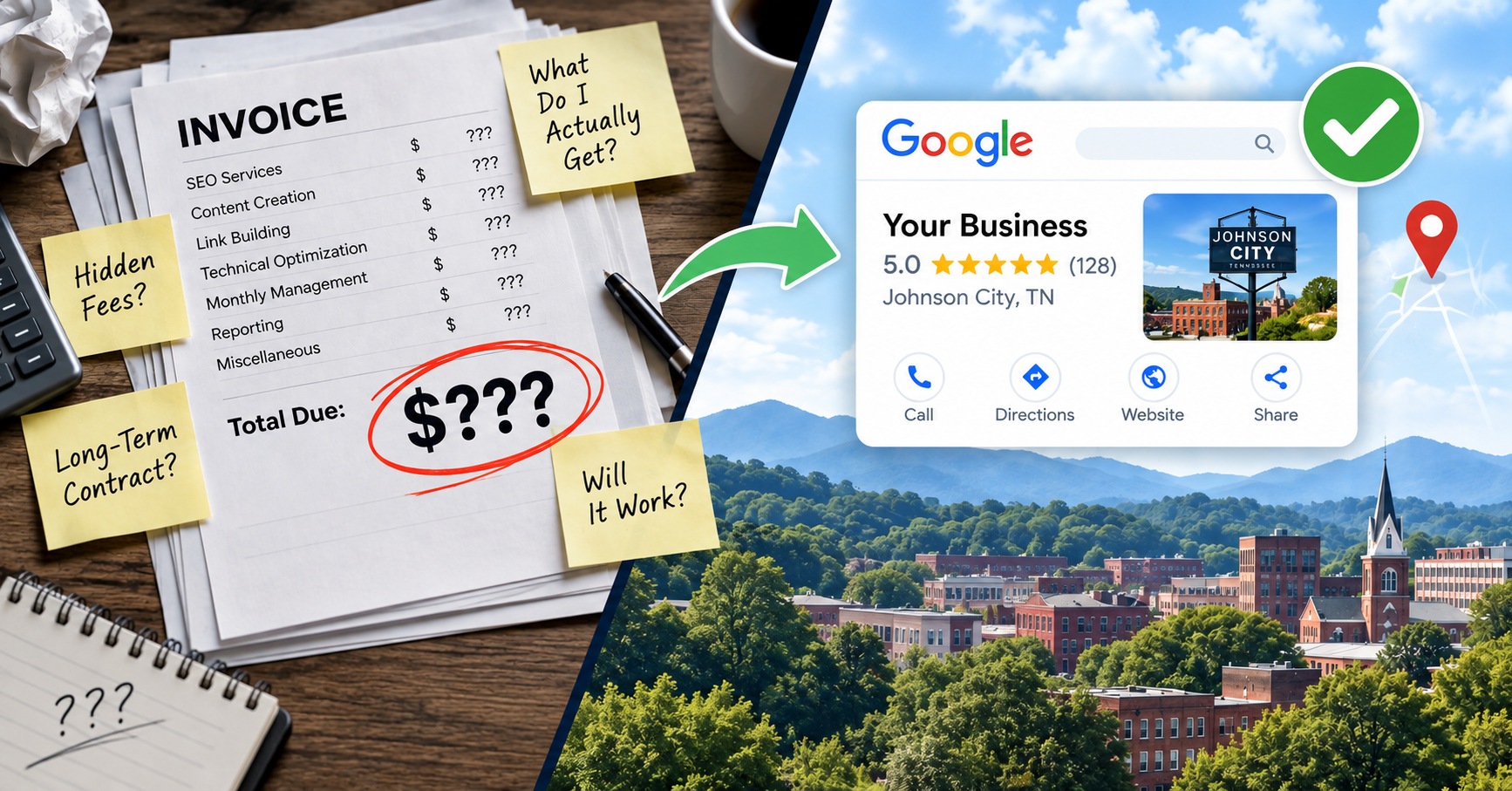

“6-12 months” is the default answer. It’s also only correct when your market, content, and citation baseline all happen to be average — and most aren’t.
Three variables determine your actual SEO timeline. Competitive density: how established are the businesses currently ranking above you? Content depth: how much well-structured content does your site have relative to those competitors? Citation baseline: how long has your Google Business Profile and directory presence been active and consistent?
When all three are average, 6-12 months is roughly accurate. When even one is favorable, you can see meaningful movement in 60-90 days. When all three are unfavorable, 18 months is a more honest expectation. Understanding which situation you’re actually in is more useful than a number that fits everyone and predicts nothing.
Table of Contents
| “6-12 months” fits every situation and predicts nothing. The actual timeline depends on three variables that differ for every business. |
Variable 1: Competitive Density
Competitive density is the strength of the businesses you’re trying to outrank. The number of competitors matters less than the quality of their SEO signals.
A market with ten poorly-optimized competitors is easier to rank in than a market with three well-established ones. The relevant questions are: How long have the ranking businesses been active? How many reviews do they have, and how recent? How complete and active are their Google Business Profiles? How much content do their sites have?
In the Tri-Cities, competitive density varies significantly by service category. Home services like landscaping and window cleaning tend to have low competitive density: established businesses with minimal SEO investment, weak GBP profiles, and thin websites. Legal, financial, and medical categories tend to have higher density, with businesses that have been around for years, accumulated hundreds of reviews, and in some cases invested in professional SEO.
The implication for timeline: in a low-density market, a well-executed local SEO campaign can break into the Map Pack within 60-90 days for a business with a reasonable existing presence. In a high-density market, the same campaign may take 9-12 months to produce comparable results because the gap to close is larger.
| How to Assess Your Market’s Competitive Density Search your primary service keyword in your city and look at the Map Pack results. Check the review count and recency for each business in the pack. Check how complete their GBP profiles are (photos, posts, services, Q&A). Visit their websites and assess content depth. Low density: businesses with under 50 reviews, sparse GBP, thin websites. High density: businesses with 100+ reviews, active GBP, multiple service pages and blog content. This tells you how much ground you need to cover before rankings move. |
Variable 2: Content Depth
Content depth is the gap between what your site currently offers and what the ranking competitors have built over time.
Google’s local algorithm uses content signals to evaluate topical relevance, specifically whether your site demonstrates enough depth on a topic to be trusted as a credible source for queries in that category. A site with a homepage and one service page for each offering is competing against sites that have those pages plus dedicated location pages, FAQ content, blog posts addressing common questions, and case studies.
The good news: content depth is the most controllable of the three variables. A consistent publishing cadence (one well-structured, specific post every two weeks) closes the content gap against most local competitors within 6-9 months. Most local businesses in most markets have almost no content investment, which means the bar to become the most content-authoritative business in your category is achievable.
The less good news: content takes time to index, crawl, and accumulate ranking signals. A post published today won’t produce ranking movement tomorrow. Google typically takes 2-4 weeks to fully index new content, and ranking movement from that content may not be visible for another 4-8 weeks after indexing. This is one reason consistent publishing cadence matters more than occasional publishing bursts: content authority compounds, but only when there’s consistent signal to compound.
| Content authority compounds over time. A business that publishes consistently for 12 months will see dramatically better results in month 13 than in month 6 — from the same effort. |
Variable 3: Citation Baseline
Your citation baseline is the age, consistency, and completeness of your business’s presence across Google Business Profile, local directories, and other online sources.
Google’s local algorithm treats citation history as a trust signal. A business that has had a consistent GBP with a stable name, address, and phone number for three years, with regular review activity and consistent directory listings across Yelp, BBB, and industry directories, starts any SEO campaign from a position of established trust. A business that recently claimed its GBP for the first time, has inconsistent NAP data across directories, or has a sparse review history is starting from a weaker foundation.
Citation baseline is the least controllable of the three variables in the short term. You can’t manufacture three years of consistent GBP history. But you can build it deliberately from today: fixing NAP inconsistencies across directories, maintaining a regular GBP posting cadence, and implementing a systematic review request process all strengthen your citation baseline faster than passive accumulation.
The timeline implication: a business with a strong citation baseline can see ranking movement from content and GBP optimization work faster than one starting from scratch, because Google already has a high confidence signal about the business entity. New businesses or businesses with a messy citation history should budget an additional 3-6 months compared to established businesses tackling the same competitive market.
The Timeline Matrix: How the Three Variables Interact
These are realistic timeline estimates for local service businesses in mid-size markets like the Tri-Cities, based on the combination of all three variables. “Movement” means measurable improvement in Map Pack position and organic impressions, not necessarily page-one rankings or significant call volume increase, which take longer.
| Scenario | Competition | Content | Citations | Time to Movement |
| Best case | Low | Some existing | Established | 60-90 days |
| Favorable | Low-Medium | Starting fresh | Established | 3-4 months |
| Average | Medium | Some existing | Moderate | 4-6 months |
| Typical start | Medium | Starting fresh | Moderate | 6-9 months |
| Uphill | High | Some existing | Weak | 9-12 months |
| Full rebuild | High | Starting fresh | Weak/new domain | 12-18 months |
These are estimates for initial movement, not the full returns of a mature SEO campaign. A business that first sees Map Pack movement at month 4 should expect meaningful call volume from SEO by month 8-10, and compounding growth well into year two.
What “Movement” Actually Means: The Three Phases
One reason the timeline conversation creates frustration is that businesses often expect the wrong thing at the wrong stage. SEO results don’t arrive all at once. They follow a predictable progression, and understanding which phase you’re in makes the process easier to evaluate.
| Phase | What to Expect | What’s Happening |
| 1 | Impressions before clicks | Google is indexing new content and starting to show it for relevant queries, but rankings are positions 8-20, where clicks are rare. You’ll see this in Search Console as impressions climbing while clicks lag behind. |
| 2 | Rankings improving, clicks starting | Content that was ranking 15-20 moves into 5-10. Map Pack visibility improves for your primary service keywords. Clicks start increasing. Calls from SEO begin. |
| 3 | Compounding returns | Multiple posts and pages ranking simultaneously. Map Pack presence across more queries. Review velocity improving. Each new piece of content builds on existing authority rather than starting fresh. |
Most businesses evaluate their SEO campaigns during Phase 1 and conclude it’s not working because the phone isn’t ringing yet. Phase 1 is the launchpad, not the result. Stopping during Phase 1 means restarting the clock every time.
What You Control vs. What Takes Time Regardless
Some SEO outcomes are accelerable with the right work. Others follow a timeline that can’t be compressed, regardless of budget or effort. Knowing the difference prevents both unrealistic expectations and misdirected investment.
Accelerable with focused work
- GBP optimization. A fully optimized Google Business Profile can improve Map Pack visibility within 2-4 weeks of implementation. Category selection, photo uploads, service additions, and Q&A population are immediate signals.
- NAP consistency. Fixing inconsistent name, address, and phone data across directories can improve local ranking signals within one to two crawl cycles, typically 4-8 weeks.
- On-page optimization. Rewriting title tags, meta descriptions, and header structure to match local search intent produces ranking movement faster than new content, because Google re-crawls existing pages.
- Review velocity. An automated review request system can meaningfully increase your review count within 30-60 days. Review recency is one of the fastest-moving local ranking signals.
Timeline you can’t compress
- Domain age and trust. A domain that’s been active for 18 months has more baseline trust than a new domain, full stop. No amount of work accelerates this. New businesses need to budget extra time.
- Content authority accumulation. Individual posts take 8-12 weeks to rank. Topical authority across a cluster of related posts takes 6-12 months of consistent publishing. The compounding effect is real but it’s not instant.
- Review history. Accumulating 100 reviews takes time even with a perfect review request system. A business getting 3-4 reviews per month reaches 100 reviews in two and a half years. There’s no shortcut.
- Competitor displacement. Pushing a well-established competitor out of the Map Pack requires accumulating stronger signals across multiple factors simultaneously. It rarely happens in under 6 months against a strong competitor.
Red Flags: When Your SEO Campaign Is Off Track
These are signs that a campaign is not progressing normally and warrants a direct conversation with whoever is running it:
- No impression growth after 90 days. Google Search Console should show increasing impressions within 60-90 days of consistent content and GBP work. Flat impressions after 90 days suggest indexing problems, thin content, or a technical issue blocking crawls.
- Reports but no Search Console access. Any SEO provider that can’t show you your own Google Search Console data is working without accountability. You should have direct access to your GSC account and be able to see raw impressions, clicks, and query data yourself.
- Keyword rankings but no calls. Rankings for keywords nobody searches are worthless. If your campaign is producing position improvements but no call volume increase, the keywords being targeted don’t match how your actual prospects search.
- Link-building as the primary activity in month 1-3. For a local service business, the first 90 days of an SEO campaign should focus on GBP optimization, NAP consistency, on-page structure, and content. Link building before the foundation is built is spending budget on the wrong problem.
| Flat impressions after 90 days means something is broken. Increasing impressions with lagging clicks is normal Phase 1 behavior. Knowing the difference prevents stopping a campaign that’s actually working. |
The Compounding Argument for Starting Now
The most important thing to understand about SEO timelines is that they’re relative to when you start. A business that started a consistent local SEO campaign 12 months ago is seeing compounding returns today. A business that starts today will see those returns 12 months from now. Every month of delay is a month of compounding that doesn’t happen.
The businesses that consistently dominate local search in a given market didn’t get there by spending more in a single month. They got there by starting earlier and maintaining a consistent signal longer than their competitors. In most local markets, that bar is not high — most competitors are doing nothing. A consistent, well-structured effort maintained for 12 months will outperform most markets regardless of starting point.
The question to ask is not ‘how fast will I see results?’ It’s ‘what will my position look like in 12 months if I start today, versus 12 months from now if I wait?’
| Want an honest assessment of your SEO timeline?1-FIND offers a free local SEO audit for Tri-Cities businesses. We’ll evaluate all three timeline variables — your market’s competitive density, your current content depth, and your citation baseline — and give you a realistic projection of what consistent SEO work will produce for your specific situation. |