
Most local businesses set it up once. A few fill in the basics. Almost none actively manage it. That’s an opportunity.
Ask most local business owners how their Google Business Profile is performing and you’ll get one of two answers: ‘I think it’s set up’ or ‘I haven’t really touched it.’ Either way, the assumption is that the GBP is a static listing, something you create once to show up in Google Maps and then leave alone.
That assumption is costing them leads.
A fully optimized, actively managed Google Business Profile is one of the most reliable drivers of inbound local leads available to a small business. It determines whether you appear in the Map Pack, how many people call you directly from search, whether prospects trust you before they visit your website, and in some categories, whether you get considered at all. For most local service businesses, the local SEO work on a GBP returns faster and more measurably than almost anything else you can do.
Table of Contents
| A Google Business Profile rewards active management the same way any other marketing channel does. Set it up once and leave it alone, and it performs like it. |
What Your GBP Actually Controls
Before getting into optimization, it helps to understand exactly what’s at stake. Your Google Business Profile controls or heavily influences:
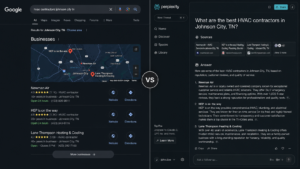
- Whether you appear in the Map Pack. The three-business block at the top of local search results, positioned above the organic listings, is the highest-visibility real estate in local search. Appearing there requires a well-optimized, actively maintained GBP. Being absent from the Map Pack for your primary service keywords means most searchers never see you.
- Your star rating and review count in search results. These display next to your business name before anyone clicks anything. A 4.8 with 47 reviews and a 3.9 with 6 reviews are making completely different first impressions at the search result level, before the prospect ever reaches your website.
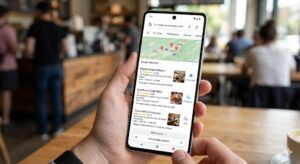
- Direct calls and direction requests from search. Your phone number, hours, and address are visible in the GBP panel without the user needing to visit your website. For mobile searches especially, a significant percentage of prospects call directly from the GBP. If your hours are wrong or your number is outdated, you’re losing those calls.
- Your Q&A, posts, and photos in the knowledge panel. When someone searches your business name directly, the right-side knowledge panel is what they see first. What’s in that panel, including photos, recent posts, answered questions, and review responses, shapes the impression they form before deciding whether to call.
- Your visibility in Google Maps. For service area businesses and businesses with physical locations, Maps visibility is a primary discovery channel. GBP optimization and Google Maps rankings are the same thing.
| How Much Traffic Goes Through GBP vs. Your Website?For many local service businesses, GBP interactions (calls, direction requests, website clicks) exceed direct website traffic from organic search.A prospect searching ‘plumber near me’ on mobile often never visits a website at all. They call directly from the GBP.This means your GBP is doing sales work your website never gets credit for, and it means GBP weaknesses (low reviews, missing info, no photos) are costing you leads you can’t see in your website analytics. |
The Complete GBP Optimization Checklist
A fully optimized GBP covers eight areas. Most businesses have done two or three of them.
1. Name, Address, Phone, and Hours
Sounds basic. It’s frequently wrong. Your business name in the GBP should match your name on your website and across all other directories exactly, character for character, including punctuation. Your address must be accurate and consistent with your other local citations. Your phone number should be a local number, not a tracking number as the primary listing. Your hours must be current, including holiday hours when relevant.
Google uses consistency across sources as a trust signal. A business whose name appears differently across listings, or whose hours are wrong, ranks lower than one whose information is consistent and accurate everywhere.
2. Primary and Secondary Categories
Your primary category is the single most important ranking signal in your GBP. It tells Google what you are. Choose the most specific category that accurately describes your primary service, not the broadest one that technically applies.
Secondary categories expand your visibility to related searches without diluting your primary ranking. A web design company whose primary category is ‘Web Design Company’ might add ‘Internet Marketing Service’ and ‘SEO Agency’ as secondaries. Each secondary category opens a new set of search queries where your listing can appear.
The wrong primary category is one of the most common GBP mistakes, and it’s one that directly suppresses your Map Pack visibility for your most important keywords.
3. Business Description
The 750-character business description is a frequently ignored field that does two things: it helps Google understand what you do in natural language, and it gives prospects who find your knowledge panel a concise reason to choose you. Write it for the prospect, not for search engines. State clearly what you do, who you serve, what makes you different, and what market you serve. Include your primary service keywords naturally, not as a keyword-stuffed list.
4. Services
The Services section lets you list specific services with names and descriptions. This is valuable for two reasons: it creates additional keyword signals within your GBP, and it tells prospects exactly what you offer without requiring them to visit your website. Add every service you provide, use the names your clients actually search for, and write the descriptions in plain language that addresses what the service solves, not just what it is.
5. Photos
Photos are one of the most consistently underdeveloped sections of local business GBPs. Profiles with strong photo libraries generate significantly more engagement than those with a logo and nothing else.
- Cover photo and logo: These display at the top of your knowledge panel and in Maps. Use a real photo that represents your business, not a stock image.
- Team photos: For any business where the client relationship matters, photos of the actual people doing the work build more trust than branded graphics.
- Work photos: Before/afters, completed jobs, your team on site. These answer the question ‘what will I actually get?’ better than any written description.
- Location photos: If you have a physical location, photos of the interior and exterior help prospects recognize the place and feel familiar before they arrive.
Add photos consistently over time rather than all at once. Regular uploads signal to Google that the profile is actively maintained.
6. Reviews
Reviews are the highest-trust signal in local search. They influence both ranking and conversion. Most businesses know they need more reviews but have no system for generating them.
The most effective review generation approach is also the simplest: ask, immediately after a positive experience, with a direct link. A text message sent within 24 hours of a completed job, with a direct link to your GBP review page, converts at a higher rate than any other method. The timing matters because the experience is fresh and the client’s goodwill is at its peak.
Responding to reviews matters nearly as much as having them. Respond to every review, positive and negative, professionally and specifically. Generic responses (‘Thanks for your kind words!’) add less than responses that acknowledge something specific about the interaction. For negative reviews, a calm, professional response that acknowledges the concern and offers to resolve it demonstrates competence and character to every future prospect reading it.
| How you respond to a negative review tells a prospective client more about your business than the negative review itself does. |
7. Posts
Google Posts are short updates that appear in your knowledge panel and can appear in Map Pack results. Most businesses never use them. That’s a missed opportunity.
Posts don’t need to be elaborate. A brief update about a completed project, a seasonal offer, a tip relevant to your service category, or a notice about changed hours keeps your profile visibly active and gives Google fresh content signals to crawl. One post every two to four weeks is enough to maintain the signal without creating a content production burden.
Posts expire after seven days unless they’re event-type posts, so a consistent posting cadence is more effective than batch uploads.
8. Q&A
The Q&A section on your GBP allows anyone to submit questions, and anyone to answer them. Most businesses don’t know this section exists until a competitor or a disgruntled customer has already populated it with unfavorable content.
Seed your own Q&A with the questions prospects actually ask before calling: What areas do you serve? Do you offer free estimates? Are you licensed and insured? What’s your typical turnaround time? Answering these questions in the GBP reduces friction for prospects who are close to calling but have one more thing they want to know.
The GBP Audit: Where Most Profiles Are Losing Ground
Run your current GBP against this checklist to identify your biggest gaps:
|
Section |
What to Check |
|
Business info |
Name matches website exactly. Phone is local and current. Hours are correct including holidays. |
|
Primary category |
Most specific accurate category selected, not the broadest one that technically fits. |
|
Secondary categories |
At least 2–3 secondaries added that reflect real services offered. |
|
Business description |
750 characters used, written for prospects, includes primary service keywords naturally. |
|
Services |
All services listed with descriptions. Names match what clients actually search. |
|
Photos |
10+ photos uploaded. Includes team, work, location. No stock images. Updated in last 90 days. |
|
Reviews |
20+ reviews. Recent reviews present. Every review has a response. |
|
Posts |
Post published within the last 30 days. |
|
Q&A |
Owner-populated Q&A with 4–6 common questions answered. |
|
Website link |
Points to the correct page, not just the homepage. |
Most businesses fail four to six of these. Each failure is a gap in your local search visibility and a missed conversion opportunity with prospects who find the profile.
GBP for Different Business Types
The core optimization principles apply across all local business types, but the emphasis differs by category.
Service area businesses (no public-facing location)
If you serve clients at their location rather than at a storefront, configure your GBP as a service area business and define your service radius accurately. Don’t list a home address as your business address. Google allows service area businesses to hide their address while still ranking in local results. Properly configured service area settings let you rank in the specific cities and counties you serve without a physical presence in each one.
Professional service businesses (accountants, financial planners, title companies)
For high-trust professional services, the review content and credential signals matter more than in other categories. As covered in the accountants and financial planners SEO post, prospects in these categories read reviews more carefully and look for specific language around trust, thoroughness, and communication. Photos of the actual team members carry more weight here than in any other category.
Retail and food service
Menu and product catalog features in GBP apply here. Hours accuracy is critical because incorrect hours create negative experiences that generate negative reviews. The booking and ordering integrations (where applicable) can drive direct conversions without a website visit.
Healthcare and wellness
Booking integration is the highest-value GBP feature for healthcare practices. Photos of the clinical environment (clean, professional, not clinical-cold) reduce anxiety for new patients. The Q&A section handles the pre-appointment questions that otherwise clog the phone line.
What Active Management Actually Looks Like
Optimization is a one-time effort. Active management is ongoing. The businesses that consistently outrank competitors in local search treat their GBP the way they’d treat any other marketing channel: with a regular cadence of activity.
On a monthly basis, that means:
- One to two Posts published, tied to something timely or relevant
- Every new review responded to within 48 hours
- Photo added if any notable work was completed
- Hours and info verified if anything has changed
On a quarterly basis:
- Review the Q&A for unanswered questions or outdated answers
- Check that your service list reflects what you’re currently offering
- Compare your category and description against what top-ranking competitors have
- Pull the GBP Insights report to see which search queries are driving views and which actions (calls, clicks, directions) prospects are taking
If you’re running business automation alongside your GBP, an automated review request sequence handles the review generation piece without requiring manual follow-up after every job. For most service businesses, this is the highest-return GBP improvement available, because review velocity is one of the strongest local ranking signals and most businesses generate reviews inconsistently.
| Review velocity matters as much as review count. Ten reviews in the last 90 days outranks 50 reviews from three years ago. |
Common GBP Mistakes That Suppress Rankings
Beyond the optimization gaps, a few specific mistakes actively hurt GBP performance and are worth calling out explicitly.
- Keyword stuffing the business name. Adding service keywords to your business name in the GBP (“Johnson City Plumbing | Best Plumber TN”) violates Google’s guidelines and can result in suspension or name edits by competitors. Your GBP name should match your legal business name.
- Using a call tracking number as the primary phone. Some tracking numbers are not recognized by Google’s local algorithm as local numbers, which can suppress local rankings. Use your local number as the primary and set up tracking at the website level instead.
- Ignoring the GBP after an edit is rejected or suspended. GBP suspensions and edit rejections happen, often for minor reasons. Leaving them unresolved means your profile may be showing incorrect information or not appearing at all. Check your GBP owner dashboard at least monthly for pending actions.
- Mismatched NAP across the web. Your Name, Address, and Phone number across Yelp, BBB, Bing Places, Apple Maps, industry directories, and your own website should be character-for-character consistent with your GBP. Inconsistencies are a local ranking suppressor that most businesses never notice because the impact is gradual.
- No response to negative reviews. Unanswered negative reviews signal that the business doesn’t monitor its profile. A professional, specific response to every negative review limits the damage and often demonstrates more character than the original complaint.
| Want to know how your GBP is actually performing?1-FIND offers a free GBP audit for local businesses in the Tri-Cities. We’ll review all nine optimization areas, show you exactly where you’re leaving visibility and leads on the table, and give you a clear picture of what a fully optimized profile looks like for your specific business type. |

Before launching 1-FIND Services, Casey spent over a decade living and working in Japan, running a web hosting business and doing high-level corporate translation work. That experience shaped a methodical, detail-first approach to marketing that you don't often find at agencies his size.
His work spans local SEO, AI-driven automation, and conversion-focused web design, areas where technical know-how and strategic thinking have to work together. That combination has made him a go-to resource for business owners trying to compete in an increasingly crowded digital landscape, and has helped establish 1-FIND Services as a recognized agency across the Tri-Cities region, including Johnson City, Kingsport, Bristol, Elizabethton, and Abingdon, VA.
What that looks like in practice:
Local & Organic SEO, getting businesses in front of the people already searching for them
Web Design, building fast, mobile-friendly websites that actually convert visitors into leads
Business Automation, helping companies work smarter with AI-powered tools and CRM integration
Google Business Profile Optimization, boosting local visibility and map presence where it counts
Casey keeps a close eye on search algorithm updates, AI developments, and how user behavior is shifting — because his clients' results depend on it. It's that combination of staying current and keeping things straightforward that defines the way 1-FIND Services operates: honest, results-driven marketing with no fluff.
- How Much Does Local SEO Actually Cost in Johnson City? What the $300 vs. $3,500 Gap Really Means - September 21, 2026
- Viking Mountain Marketing Joins Forces with 1-FIND SERVICES - September 4, 2026
- Plumber Marketing: How to Fill Your Schedule in the Tri-Cities - August 12, 2026